
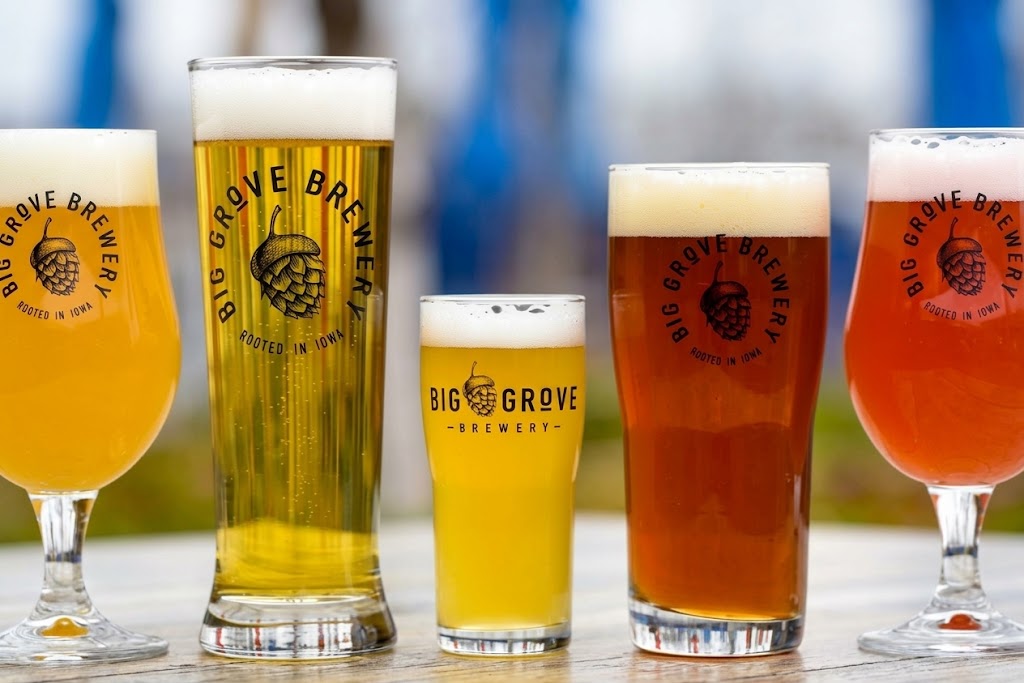
When Andy Joynt came on at Big Grove Brewery, he was not a seasoned professional brewer, and neither were most of the people around him. More than ten years later, he is the company’s director of brewery operations, overseeing a production brewery in Iowa City and the construction of brewing facilities in taprooms across the Midwest. In a return visit to the Midwest Microbrew podcast, he told host Henry how that lack of experience became a strength, what the brewery is doing now, and where it is headed next.
The Past: Learning the Craft by Breaking the Rules
A team without a rulebook
Joynt has been with Big Grove for ten and a half years, and he is quick to say he did not arrive as a polished professional. “I wasn’t particularly well trained in professional brewing when I came on at Big Grove, nor was most of our staff,” he says. The early years were spent learning the equipment: how to use it, and how to use it well.
That inexperience came with an unexpected advantage. Without years of habit to unlearn, the team felt free to test the limits of the equipment, to make the occasional mistake, and to keep asking “what if we did this?”
The centrifuge experiment behind Easy Eddy
Nowhere is that mindset clearer than in the story of Easy Eddy, the hazy IPA that now anchors the company. When Big Grove began brewing it in 2017, hazy IPAs were still a new and unsettled style. The team’s primary goal was flavor and aroma, but along the way they stumbled into a second benefit: a way to extend the beer’s shelf life and make it more consistent from can to can.
It started with a hunch. The production brewery had a centrifuge, a machine that spins beer at high speed to pull out solids such as hops and yeast before sending the finished beer to its tank. While finishing one batch, Joynt wondered what would happen if he ran it through. The idea seemed backward, since brewers at the time were obsessed with building and keeping haze. But when the machine ejected its first load of solids, he tasted the discarded liquid and found it harshly bitter. “Maybe this isn’t a bad thing at all,” he remembers thinking.
A few brewers tasted the result and agreed it kept what they wanted and left out what they didn’t. By the fourth or fifth batch the process was settled, and every batch of Easy Eddy since has gone through the centrifuge. The beer has since won a gold medal at the Great American Beer Festival.
The day Eddy fought back
Not every lesson was a clean success. Early on, Joynt was dry hopping a batch, which means adding hops during or near the end of fermentation to encourage interaction between hops and yeast. The trouble is that actively fermenting beer is saturated with carbon dioxide, and hop pellets give the gas something to cling to, so the beer can foam violently. The fermenters weren’t filled to the top back then, so he figured twenty or thirty barrels of headspace was a generous buffer.
“But on that day, Eddy was particularly angry,” he says. Standing in a bucket lift fifteen feet up, he had dumped in two bags of hops when foam began creeping out of a four-inch port, then turned into a jet of beer that hit the ceiling and rained down on him. Reaching for the controls, he apparently hit the lift’s emergency stop, and he spent twenty or thirty seconds with beer blasting him and nowhere to go. The fix was practical: four-inch valves, so that “if the beer got a little spicy you could just cap it off and walk away.”
The Present: A Growing Network of Taprooms
Omaha: a plan rewritten by a license
Big Grove opened its Omaha taproom late last fall and has just passed the one-year mark, but the road there did not go as planned. The brewery did not get the license it was expecting, which means every beer sold in the Omaha taproom has to be brewed at that location. Normally, a new taproom pours mostly beer shipped from Iowa City, with four or five lines left for local exclusives.
Instead, Omaha’s entire lineup is brewed on site and changes weekly. “It’s kind of a fun situation, but it was a little bit of adaptation for us,” Joynt says.
Kansas City: a launch that outran the beer
The Kansas City taproom, which opened in May in the Prairie Village neighborhood, went the opposite way. Construction hit its timelines, the doors opened on the intended dates, and the neighborhood turned out to be “kind of hungry for a space and a concept like Big Grove provides.” Joynt describes the opening as “gangbusters from the day we opened the doors.”
The crowds were so large that, for the first month or two, the taproom had to close one day a week because it kept running out of beer and the staff needed a day to reset. “It was a great situation to be in,” Joynt says. “It was just we were a touch overwhelmed by it.”
The engine room on Liberty Drive
Behind every taproom is the production brewery in Iowa City, which turns out ninety-five to ninety-eight percent of the beer Big Grove makes. It was purpose built with an engineering firm, and Joynt says the team has gotten much better at running it in the two years since brewing began there. Much of it comes down to efficiency, including recovering as much liquid as possible so it ends up in a can or keg.
About twenty-four people work at the site, from the quality lab to production, packaging, and warehousing. Every Big Grove taproom includes its own small brewing facility and brewer, so a build means designing the brewery, buying equipment, and coordinating contractors, deliveries, and utilities. And the flagship is still Easy Eddy, which Joynt estimates makes up about sixty percent of the company’s volume. Brewbound reported in 2023 that Big Grove had overtaken Blue Moon as Iowa’s best-selling craft brand.
Reading the Market: Beer’s Two Growth Edges
Deciding what stays and what goes
Because Big Grove is heavily distributed, decisions about which beers to keep brewing start with sales velocity. The team weighs how much effort has gone into a brand, how long it has been around, and where its sales are trending. A steady decline forces a choice: keep making it, or retire it. Sometimes the answer is more marketing and energy rather than a goodbye.
It is not always easy. Some older brands still have loyal fans, but “at a certain point” the numbers say it is time to move on. To keep the lineup fresh, the company uses its own taprooms as a test kitchen. New beers can launch within the network, where the team gets a feel for how customers react and tweaks the recipe before sending the beer out into full distribution.
Playing both ends of the ABV spectrum
According to Joynt, the middle of the market, beers in the five to eight percent range, is declining, while both very high and lower alcohol beers are growing. Big Grove is playing in both. Royal Eddy, at nine percent, has been a solid brand, though Joynt notes it sits at the bottom end of what high-ABV drinkers look for. This year the brewery went further with Triple Eddy at eleven percent, and put it in a small eight-ounce can, “a little bit of innovation” and a test of the growing interest in smaller formats.
On the other side is Easy Going, a 3.6 percent beer built to echo the aroma and flavor of Easy Eddy. Joynt says it is much easier to have “two, three, four” without feeling what a six or seven percent beer would do. For a brewery built around gathering with friends, he sees real appeal in that: you can still sit through a few rounds without taking in that much alcohol.
Friends in the industry
Joynt calls himself a craft beer fanboy of twenty-five years, and the brewery he singles out for respect is Half Acre in Chicago. The connection began when Big Grove bought a grain mill from them for its Cedar Rapids taproom, the original prototype of a Sasquatch mill. A Half Acre finance team member from Iowa City has kept the beer swaps and visits going. “They make some really great beers,” Joynt says, “and they’re always innovating in some fun categories.”
What Makes a Brewer: Curiosity and Follow-Through
Asked what he looks for in a new brewer, Joynt says curiosity and the discipline to follow through on details. Brewing, he explains, is not simple, but it is repetitive. A brewer moves through very similar steps to make, ferment, and finish every beer, and “the devil’s in the details.” Quality and flavor are defined by each small task performed along the way.
That is why he values people who are “very curious about the whys” and who keep asking what-if questions, the same instinct that led him to put a hazy IPA through a centrifuge. But curiosity alone is not enough. The brewers who develop into the best, he says, also execute each task carefully, record the data, and keep track of what they did and what resulted. For aspiring brewers, the advice is concrete: ask questions, run small experiments, and write everything down.
The Future: Tailgates, Seasonal Menus, and Something New Every Week
Tiger Hawk takes the field
The biggest hitter on Big Grove’s immediate horizon is Tiger Hawk, a beer made in partnership with the University of Iowa. It arrived this summer in a can covered in Iowa branding, with nods to Iowa football and athletics, and the brewery has been pushing it hard for tailgating season. It is available at Kinnick Stadium and will be at Carver-Hawkeye Arena, and the team has set up tailgates by the stadium for the last three games to show it off.
Fresh menus, fresh beer
On the taproom side, Joynt says menus change often at most locations, leaning into whatever produce is in season. His pitch to anyone who has not visited lately is simple: check the menu, and try a beer you have not had. Instagram and Facebook carry the news, but the staff are well versed in what is coming up, and “we’re always trying to show people a good time.”
Off the clock
After a long day, Joynt still reaches for a West Coast IPA, and his favorite pairing is an IPA with something spicy. His favorite season to brew is fall, when fest beers and Märzen-style beers come around and the production brewery, which is not air conditioned, finally cools off after a summer of boiling and steam piping. As Big Grove adds taprooms and tests new formats, the habits of its early days, curiosity and a willingness to try the unexpected, are still steering the ship.
Connect with Big Grove Brewery
To see what’s new on the taps and menus, follow Big Grove online or stop by a taproom, such as the Iowa City location. For more Iowa breweries, browse Midwest Microbrew’s Iowa guide.
Facebook: Big Grove Brewery
Website: biggrove.com
Instagram: @biggrovebrewery
FULL INTERVIEW:

