“The beer that made Milwaukee famous” was never just a slogan. For decades, the Midwest’s breweries quite literally defined American beer history. But look closer, and this region’s story isn’t really one long success — it’s a story of cycles, swinging from boom to bust and back again, and it gives us one of the clearest windows into the evolution of American craft beer anywhere in the country. There’s the 19th-century immigrant boom, the near-extinction under Prohibition beer laws, decades of post-prohibition macro beer dominance, and finally a craft beer revival after Prohibition that built one of the densest brewery scenes in America. So consider this your craft beer guide to the history of craft beer in the Midwest: how its beer culture was destroyed, how it clawed its way back, and why it’s being tested all over again right now.
How Prohibition Affected the Beer Industry in the Midwest
The German Roots of Midwest Beer Culture
To really understand the impact of Prohibition on American breweries, you have to picture what the Midwest had to lose in the first place. The region’s brewing identity was forged by German immigrants who arrived in the 1840s and 1850s, and they brought everything with them: lager yeast, beer-garden culture, and serious technical know-how that became the foundation of the entire history of beer brewing in the Midwest. By 1880, Milwaukee’s German population had climbed to 27% of the city, the highest concentration of any single immigrant group in any American city at the time, and brewers like Frederick Miller, Joseph Schlitz, Frederick Pabst, and Valentin Blatz built the breweries that would become some of the most famous Midwest beer brands in history. Wisconsin alone had roughly 200 breweries by 1860, with over 40 of them in Milwaukee, and that same German diaspora seeded breweries all across the region, from August Schell in New Ulm, Minnesota (1860) to Stevens Point in Wisconsin (1857) to Jacob Leinenkugel in Chippewa Falls (1867). Brewing wasn’t some side hustle, either. It was Milwaukee’s fourth-largest industry before Prohibition hit.
Prohibition Beer Laws and the Collapse of Midwest Brewing
Then came the 18th Amendment, and everything changed almost overnight. The Volstead Act’s ban on manufacturing, selling, or transporting alcohol took a thriving regional economy and turned it into wreckage. As Central Michigan University economist Jason Taylor explained in an interview on Prohibition’s economic toll, of the roughly 1,400 U.S. breweries operating before Prohibition, only around 200 managed to survive intact, and when legal beer finally returned on April 7, 1933, just 133 breweries were licensed to sell it. Cincinnati’s once-thriving brewing scene, anchored by names like Christian Moerlein, was effectively wiped out, which is a sobering data point in any honest accounting of beer industry history.
How Surviving Breweries Adapted to Prohibition
The breweries that made it through didn’t survive by brewing beer, because they couldn’t. Pabst struck “Brewing” from its name and started selling a processed cheese spread called Pabst-ett, moving more than eight million pounds of the stuff (and getting sued by Kraft along the way). Schell’s turned to near beer, soft drinks, and candy. Detroit’s Stroh’s leaned on near beer, soft drinks, and ice cream production that kept going for decades afterward. Anheuser-Busch diversified into brewer’s yeast, malt extract, ice cream, and a non-alcoholic near beer called “Bevo.” Prohibition also pushed drinking habits toward hard liquor, since it was simply easier for bootleggers to move than bulky beer, and it drove brewing into private homes, quietly planting a homebrewing tradition that wouldn’t become legal again for another 45 years.
Post-Prohibition Macro Beer Dominance: The Consolidation Era (1945–1980)
Repeal didn’t bring the old regional brewing landscape back, not even close. Instead, the decades after World War II became the defining era of post-prohibition macro beer dominance, and the numbers tell the story on their own: the number of U.S. breweries fell from roughly 700 in 1935 to under 400 by 1950, to about 125 by 1970, and finally to a post-Prohibition low of just 89 plants controlled by 42 companies by the late 1970s. Meanwhile, the share of national beer sales held by the ten largest brewers rocketed from 38% in 1950 to 93% by 1980, driven by national television advertising, refrigeration and transport advances, and a wave of acquisitions that squeezed out smaller regional players who simply couldn’t compete on a per-viewer ad-spend basis.
The Schlitz Story: A Midwest Cautionary Tale
No story captures this era better than Schlitz, and it’s worth telling in full because it’s basically a morality play. Founded in Milwaukee in 1849, Schlitz became the world’s largest brewery by 1902 and America’s #1 beer in the 1950s, brewing over 4 million barrels a year at its peak. Then, chasing efficiency, the company adopted accelerated batch fermentation in 1967 and swapped in cheaper ingredients, corn syrup for malted barley and hop pellets for fresh hops, in what’s remembered as “the Schlitz Mistake” of the mid-1970s. A 1976 stabilizer change caused a haze that forced the company to dump millions of bottles, a notorious “Drink Schlitz or I’ll kill you” ad campaign backfired badly, and a 1981 strike led the board to shutter the historic Milwaukee plant for good. The brand was sold to Stroh in 1982, then to Pabst in 1999, and as Gear Patrol’s history of Milwaukee brewing puts it, the beer that made Milwaukee famous became the beer that made Milwaukee furious. Heritage brewers like Schell’s survived this era on regional loyalty alone, and at one particularly low point, the brewery sold lumber from a black walnut tree on its own grounds just to stay solvent.
The Rise of Microbreweries in the 1980s: Midwest Craft Beer Pioneers and Founders
The Spark Behind the Craft Beer Revival After Prohibition
To explain how craft beer became popular in the Midwest, and really the broader history of microbreweries in America, you actually have to start in San Francisco. The national revival is usually traced back to Fritz Maytag, heir to the Maytag appliance fortune, who bought a controlling stake in the failing Anchor Brewing Company in 1965 and became sole owner by 1969. His all-malt Anchor Steam and hop-forward Liberty Ale became the template for what “craft beer” would even mean, which is how Maytag ended up earning the nickname “the father of craft beer.” The other essential piece was legal, not brewing-related at all: in October 1978, President Carter signed H.R. 1337, federally legalizing homebrewing for the first time since Prohibition. That single law is arguably the starting gun for the entire 1980s craft beer movement, since almost every founder of the era got their start as a homebrewer experimenting in a kitchen.
Real Ale Company and Bell’s Brewery: Michigan’s Microbrewery Pioneers
The Midwest’s literal first spark, though, actually predates even Bell’s. In the small town of Chelsea, Michigan, in early 1982, a 31-year-old cook named Ted Badgerow teamed up with dairy farmer Gordon Averill to found the Real Ale Company, brewing traditional English-style bitters in repurposed stainless steel dairy tanks and hand-bottling the result four at a time using recycled Guinness and Bass bottles. The novelty was enough to land a feature in Time magazine and even a visit from Hall & Oates, who reportedly interrupted a Canadian tour just to buy seventy cases. The Real Ale Company couldn’t raise the expansion capital it needed and closed in 1986, but not before it inspired a young visitor named Larry Bell, which makes it one of the great overlooked Midwest microbrewery success stories.
Bell ran a homebrew supply shop in Kalamazoo, Michigan, and after visiting Real Ale Company in 1983, he started brewing test batches in a converted 15-gallon soup kettle. He sold his first commercial beer on September 19, 1985, producing just 135 barrels in that entire first year, which made Bell’s Brewery (originally Kalamazoo Brewing Company) the oldest craft brewery in Michigan and the oldest one east of the Rockies. Bell later worked with state legislators to change Michigan law so breweries could open onsite pubs, which led to the 1993 opening of Bell’s Eccentric Café. Its flagship Two Hearted Ale, an all-Centennial-hop IPA, has repeatedly been voted America’s best beer, and it’s one of the clearest examples of how the rise of microbreweries in the 1980s reshaped American taste for good.
Summit Brewing and the Minnesota Craft Beer Revival
In St. Paul, a former chemical-dependency counselor named Mark Stutrud spent years quietly planning his exit from corporate life. In October 1983, he received a blunt warning letter from the Brewers Association of America’s executive secretary, who told him flat out that it was “a long and hard road” he was planning to go down. He went anyway. Stutrud raised $600,000 through savings, an SBA loan, city development funds, and twenty local investors, and incorporated Summit Brewing Company in 1984 inside a converted auto-parts warehouse on University Avenue. The first kegs of Summit Extra Pale Ale shipped out to Twin Cities taverns in September 1986, marking Minnesota’s first new brewery in over 120 years.
Goose Island, Great Lakes, and New Glarus: The Breakthrough Generation
Chicago’s contribution came from John Hall, a corrugated-box executive who came back from a European pub tour determined to open something similar, and he launched Goose Island as a Lincoln Park brewpub in 1988. Under his son, brewmaster Greg Hall, Goose Island went on to pioneer bourbon-barrel aging with Bourbon County Stout, though the exact birth year is genuinely disputed. Official marketing has long pointed to 1992, but reporting from journalist Josh Noel and interviews with early brewery staff suggest the Jim Beam barrels didn’t actually arrive until late 1994, with the first keg not tapped until 1995. Either way, it launched an entire category of barrel-aged beer and remains one of the more debated footnotes in craft beer history.
That same year, 1988, brothers Pat and Dan Conway opened Great Lakes Brewing in Cleveland’s depressed Ohio City neighborhood, marking the city’s first new brewery since its last production facility closed in 1984. They merged three Victorian-era buildings into one space, hired a retired master brewer, and named their beers for local lore, including Eliot Ness Amber and the now-iconic Edmund Fitzgerald Porter. Then in 1993, Deb and Dan Carey founded New Glarus Brewing in Wisconsin, with Deb raising the startup capital herself, making her the first woman to found and operate a brewery in the United States. And further south, Schell’s heritage brewery, founded all the way back in 1860, had quietly survived every single era described above and remains America’s second-oldest family-owned brewery, still pouring beer in New Ulm today. Together, these founders are the backbone of any serious list of Midwest craft beer pioneers and founders.
Iconic Midwest Craft Breweries and Today’s Microbrewery Boom
Midwest Brewery Counts and the Modern Boom
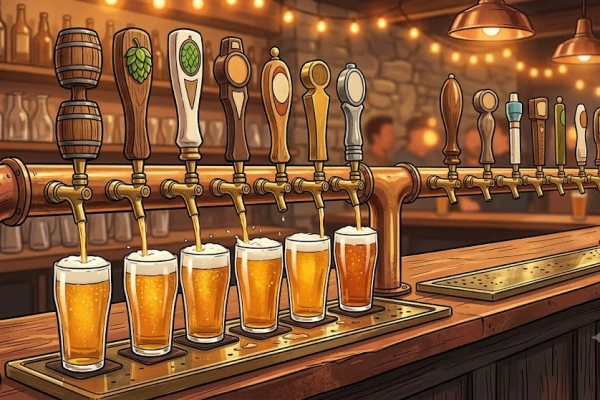
So what does the growth of the craft beer industry over time actually look like on the ground today? By recent counts, Ohio (421 breweries) and Michigan (420) rank 8th and 9th nationally, with Wisconsin and Minnesota leading the entire country in breweries per capita, which is a remarkable density for a region that nearly lost its whole brewing industry not once but twice. If you’re sketching out a Midwest brewery history timeline, this is the payoff: a region that went from roughly 89 surviving plants nationwide in the late 1970s to one of the most brewery-dense corners of the country today.
But the craft beer boom explained honestly also means reckoning with a correction, and that part of the story matters too. According to the Brewers Association’s 2024 industry report, 2024 was the first year since 2005 that closures (501) outpaced openings (434), a net loss of 67 breweries, while craft beer volume fell 4.0% to 23.1 million barrels.
Ownership Shifts and Independent Holdouts Among the Best Craft Breweries in the Midwest
Ownership has shifted too, and not always in the direction you’d hope. Goose Island was sold to AB InBev for $38.8 million in 2011; Bell’s was sold to Lion, a subsidiary of Japan’s Kirin, at the end of 2021; and Founders, in Grand Rapids, eventually moved to full ownership by Spain’s Mahou San Miguel. By the Brewers Association’s own definition, none of these breweries count as “craft” anymore. New Glarus, by contrast, made the contrarian choice to distribute only in Wisconsin, and it still grew into roughly the 12th-largest craft brewery in the country by volume. Great Lakes, Summit, and Schell’s also remain independent, and any current ranking of the best craft breweries in the Midwest really should account for that distinction.
There’s a real silver lining for the region, though. The Brewers Association’s 2025 update on the industry correction found that the Midwest’s East North Central division, made up of Ohio, Indiana, Illinois, Michigan, and Wisconsin, was the strongest-performing region in the entire country, posting +0.4% growth even as the national picture kept softening. That regional resilience is one of the clearest modern craft beer trends in the Midwest right now, and it’s a good sign that the fundamentals here remain stronger than the national headlines might suggest.
The Cycle Continues
From soup kettles and converted dairy tanks to a region now weathering its own correction, Midwest craft beer keeps circling back to the same basic lesson: market structure and regulation, not taste alone, tend to decide who survives and who doesn’t. The independent holdouts, like New Glarus staying Wisconsin-only, Schell’s surviving on regional loyalty since 1860, and Great Lakes building out employee ownership, may end up being the model that proves most durable of all. And if you’re planning a trip through the region, good news: many of these pioneer breweries are still open for visitors today, and their stories are well worth a stop of their own.