Best Midwest Craft Beer Breweries for IPA Lovers: 2026 Guide
Walk into any great craft beer bar in the Midwest today and the tap list says it all. On one end you’ve got a West Coast IPA — clear, sharp, and bitter. In the middle, two or three hazy IPAs crowd the board. Then there’s a session IPA for the folks who pace themselves, and a double IPA for the hop heads who never will. That mix didn’t happen overnight. It’s the result of twenty years of change, and right now the Midwest is the most exciting place in the country to watch the evolution of IPA beer styles in America play out.
The numbers back it up. The national craft beer industry fell 5.1% in production in 2025, and more breweries closed than opened for the first time in the modern era. Yet the East North Central states — Illinois, Indiana, Michigan, Ohio, and Wisconsin — were the only U.S. region to grow, up 0.3%. IPA beer drives roughly 46–50% of all craft beer sales nationwide. It’s the engine behind the Midwest’s edge. This guide covers all four core IPA styles, gives you a straight hazy IPA vs West Coast IPA comparison, and spotlights the top Midwest IPA breweries 2026 has going — including the best craft IPAs in the Midwest across every style.
- Best Midwest Craft Beer Breweries for IPA Lovers: 2026 Guide
- How West Coast IPA Became Popular in the Midwest
- IPA Beer Styles Explained: West Coast, Hazy, Session, and Double IPA
- Why Hazy IPAs Are Trending in the Midwest
- Top Midwest IPA Breweries 2026: Best Craft IPAs by Style
- How to Choose Between IPA Styles: A Quick-Pick Guide
- Midwest Craft Beer in 2026: The Best IPA Lineup in the Country
How West Coast IPA Became Popular in the Midwest
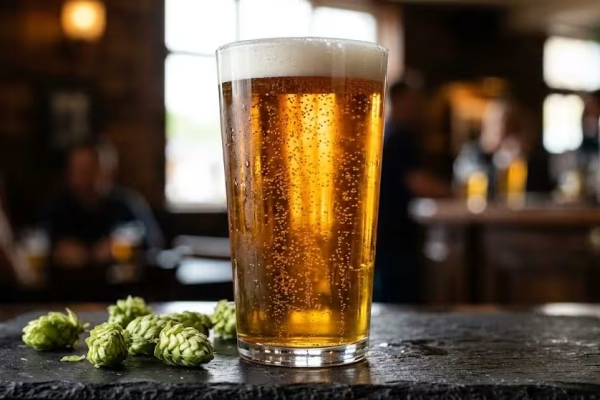
The craft IPA started life in England as a heavily hopped ale built to survive a long sea voyage to India. American craft brewers brought it back in the 1970s and ’80s. By the late ’90s, Pacific Northwest breweries had turned the West Coast IPA into the style every serious craft beer fan wanted. It was clear, dry, and loaded with pine and citrus from the “C-hops” — Cascade, Centennial, Chinook, and Columbus. Midwest brewers didn’t just copy it. They softened the edge with more malt backbone, and that gave us craft IPAs like Bell’s Two Hearted Ale, first brewed on August 15, 1997, that still define the region today. Better distribution and the free flow of brewing know-how online did the rest — they turned a California style into a Midwest staple.
The hazy chapter started when John Kimmich brewed the first batch of Heady Topper at The Alchemist in Vermont in early 2004. The Brewers Association made “Juicy or Hazy” an official style in March 2018. Then on May 23, 2023, the BA gave West Coast-Style IPA its own category. They called it “highly attenuated… dry, crisp finish,” landing at 6.3–7.5% ABV and around 50–70 IBU. That was a clear message from the trade body: the original American IPA was worth protecting, not just remembering.
IPA Beer Styles Explained: West Coast, Hazy, Session, and Double IPA
The best way to compare IPA styles is across four points: Aroma, Flavor, Mouthfeel, and ABV.
Click any column header to sort the table
| Style | ABV | IBU | Clarity | Aroma & Flavor | BJCP |
|---|---|---|---|---|---|
| West Coast IPA |
5.5–7.5%
|
40–70
|
🔵 Clear | Pine, resin, citrus, dry finish | 21A |
| New England / Hazy IPA |
6.0–9.0%
|
25–60 *
|
🟠 Opaque | Tropical fruit, stone fruit, soft mouthfeel | 21C |
| Session IPA |
3.0–5.0%
|
Varies
|
⚪ Varies | Hop-aromatic, light body | 21B |
| Double / Imperial IPA |
7.5–10%+
|
60–120
|
⚪ Varies | Intense hops, malt sweetness, alcohol warmth | 22A |
* Hazy IPA perceived bitterness is low despite moderate measured IBU, due to biotransformation during dry-hopping. Source: BJCP 2021, Category 21C — bjcp.org
West Coast vs New England IPA: What’s the Difference?
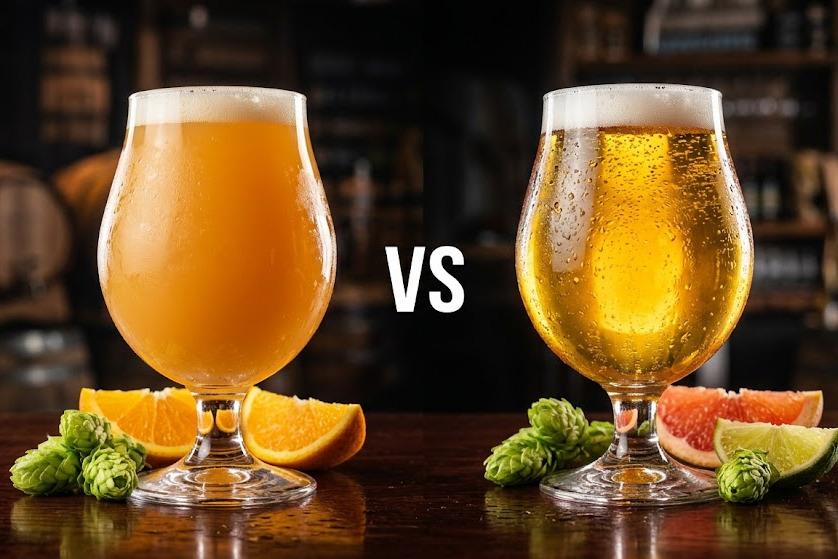
The differences really come down to one thing. West Coast IPAs are crisp and bitter. New England IPAs are soft and juicy. West Coast brewers build their bite through hops added during the boil, finishing the beer bone-dry. New England brewers load most of their hops into the whirlpool and add more during active fermentation — a step called biotransformation. That draws out bold fruit aromas without the hard bite of a long boil. At its core, the hazy IPA vs West Coast IPA comparison is this: sharp and clean on one side, smooth and ripe on the other.
What Is a New England Style IPA?
The BJCP files it as category 21C. It’s cloudy by design — high-protein grains like oats and wheat do that. It smells like a fruit bowl, bites like almost nothing, and feels soft and full in the glass. New England IPA breweries outside the Northeast now make world-class versions of this style. Some of the best are right here in the Midwest.
Session IPA vs Regular IPA: Alcohol Content and Body
A standard American IPA sits at 5.5–7.5% ABV. A session IPA stays in the 3.0–5.0% range. The hard part is keeping bold hop flavor at that lower strength when there’s less malt to lean on. Done well, it’s the best IPA to drink all day. Done poorly, it just tastes thin.
Double IPA vs Imperial IPA: What Is the Difference?
There isn’t one. Both names point to BJCP category 22A, which runs 7.5–10%+ ABV. They’re two labels for the same thing: big, hop-loaded, and strong.
Why Hazy IPAs Are Trending in the Midwest
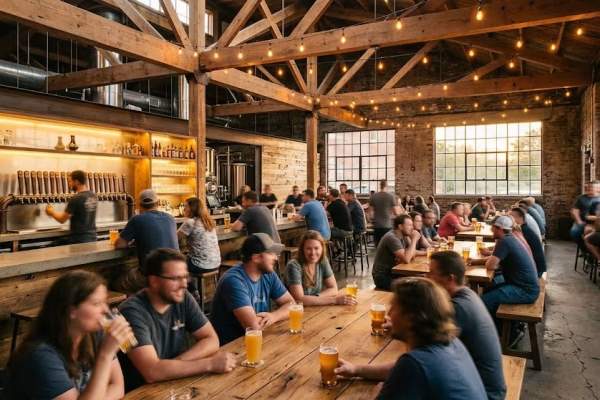
Three things pushed hazy IPAs to the top of Midwest tap lists. One real force has started to push back.
- Lower bitterness opens the door. Little Miami Brewing in Cincinnati put it well: “Less bitterness meant more of us could enjoy IPAs without the face-puckering shock. Even IPA skeptics found themselves reaching for a hazy.” That softer profile brought a whole new wave of drinkers into craft beer.
- These beers are made for social media. Untappd’s 2024 Year in Beer data named hazy IPAs the most checked-in IPA type in the whole country. A beer that looks like orange juice and smells like a fruit stand is easy to shoot and easy to share. West Coast styles just can’t match that kind of camera presence.
- Big Midwest names went all in. Bell’s launched Hazy Hearted Ale. Revolution made Hazy-Hero a full-time part of its lineup. When Great Lakes Brewing released its Midwest Hazy IPA in 2025, it quickly became the brewery’s second best-selling year-round brand. The best hazy IPAs from Midwest breweries now hold their own against any in the country.
The pushback is real, though. “Hazy fatigue” is a phrase you’ll hear from brewers all over. The BA’s 2023 move to give West Coast IPA its own official style category was a signal that the original American craft IPA still has a big, loyal crowd — and that crowd is growing again.
Top Midwest IPA Breweries 2026: Best Craft IPAs by Style
These craft IPA breweries in Illinois and Ohio — and all across the Midwest — are making the best craft IPAs in the region right now. Every one of these Midwest microbreweries with award winning IPAs covers a different part of the style map.
8 breweries shown
Click any column header to sort
| Brewery | Location | Flagship IPA | Style | Ratings & Awards |
|---|---|---|---|---|
|
Bell’s Brewery
Kalamazoo, MI
|
Kalamazoo, MI | Two Hearted Ale | West Coast IPA | |
|
Fat Head’s Brewery
North Olmsted, OH
|
North Olmsted, OH | Head Hunter IPA | West Coast IPA | |
|
3 Floyds Brewing
Munster, IN
|
Munster, IN | Zombie Dust | Citra Pale Ale | |
|
Surly Brewing
Minneapolis, MN
|
Minneapolis, MN | Furious | American IPA | |
|
Revolution Brewing
Chicago, IL
|
Chicago, IL | Anti-Hero / Hazy-Hero | Hazy IPA | |
|
Founders Brewing
Grand Rapids, MI
|
Grand Rapids, MI | All Day IPA | Session IPA | |
|
Toppling Goliath
Decorah, IA
|
Decorah, IA | King Sue | Double Hazy IPA | |
|
Rhinegeist Brewery
Cincinnati, OH
|
Cincinnati, OH | Juicy Truth | Hazy IPA |
Ratings from BeerAdvocate (BA), Untappd, and Craft Beer & Brewing (CB&B) as of May 2026. Crowdsourced scores favor rare and fresh beers — use as a guide, not a verdict. Award data: World Beer Cup (WBC) and Great American Beer Festival (GABF) 2023.
A word on ratings: Untappd and BeerAdvocate scores lean toward rare, high-ABV, and hazy beers. Users tend to align with the scores they see first, and hard-to-find beers get a boost just from being scarce. Use these as a starting point, not the final word.
Bell’s Two Hearted Ale (7.0% ABV, 55 IBU, 100% Centennial hops) is the BJCP’s own benchmark for category 21A American IPA. It won Zymurgy’s “Best Beer in America” poll four years in a row — 2017 through 2020. One thing worth knowing: Bell’s was sold to Lion Little World Beverages, a Kirin subsidiary, in 2021. It’s no longer an independent craft brewery.
Fat Head’s Head Hunter IPA (7.5% ABV) became the first IPA in history to win gold at both the World Beer Cup (411 entries) and the GABF (205 entries) in the same year — 2023. Brewmaster Matt Cole told Cleveland Scene: “Nobody has ever won gold medals for American-style IPA within the same year at the Great American Beer Festival and the World Beer Cup.”
The top rated double IPAs in the Midwest include Toppling Goliath King Sue (8.2% ABV, 100% Citra), Bell’s Double Two Hearted (BeerAdvocate 92), and Revolution Imperial Anti-Hero (BeerAdvocate 91). For the top rated hazy IPAs at Midwest craft breweries, Revolution Hazy-Hero, Rhinegeist Juicy Truth, and Great Lakes Midwest Hazy IPA lead on reach and ratings alike. King Sue is a world benchmark for the Double Hazy IPA style — and it comes from a small town in rural Iowa.
For a low ABV session IPA from Midwest breweries, Founders All Day IPA (4.7% ABV, 42 IBU) is the clear first pick. It has 565,000+ Untappd ratings and a 91/100 from Craft Beer & Brewing. Worth knowing: Founders has faced workplace culture issues in recent years, and some readers will want to weigh that before buying.
How to Choose Between IPA Styles: A Quick-Pick Guide
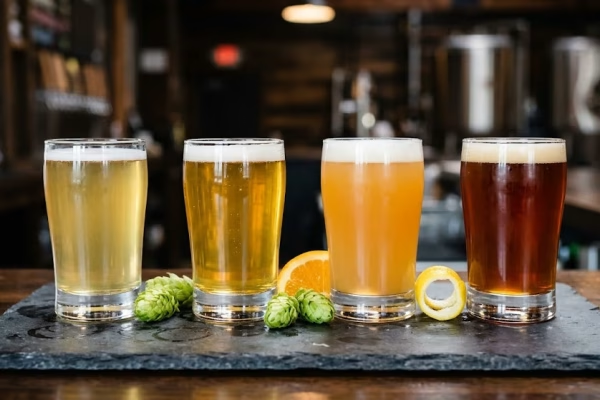
Not sure what to grab? Whether you’re at one of the best craft beer bars in the Midwest or just facing a long tap list for the first time, four questions will point you in the right direction and show you how to choose between IPA styles.
- Bitter or soft? If you love a dry, sharp finish, go West Coast IPA. If you’d rather have something smooth and fruit-forward, pick a hazy IPA or New England IPA.
- Session or sip slowly? If you’re in for a long afternoon, a session IPA under 5% ABV is your best bet. If you want one big, bold pour to end the night, a double IPA at 7.5–10%+ is the call.
- Clarity or aroma? West Coast IPAs pair well with food and let the hops and malt work together cleanly. Hazy IPAs hit you with aroma first — dense, tropical, and loud from the first sniff.
- How fresh is the can? Hazy IPAs are best within four to eight weeks of canning, after which the hop oils fade fast. West Coast IPAs hold up for three to four months. Always check the date on the can.
New to IPA beer? The best low ABV session IPA entry point from Midwest breweries is Founders All Day IPA (4.7% ABV) or Rhinegeist Juicy Truth. Both are easy to find, low on bite, and a great way to start.
Midwest Craft Beer in 2026: The Best IPA Lineup in the Country
The Midwest’s best craft beer story in 2026 isn’t about one style winning out. It’s about the region building the most well-rounded IPA lineup in the country. Bell’s, Revolution, Founders, Toppling Goliath, and Fat Head’s all make strong craft IPAs across every lane — West Coast, hazy, session, and double. The best Midwest craft beer breweries for IPA lovers have stopped picking sides, and that’s a big part of why they keep winning.
The West Coast resurgence is real and picking up pace. Hazy IPAs aren’t going anywhere. Session hazies are the next wave, pushed along by younger drinkers who want bold flavor at lower ABV. The evolution of IPA beer styles in America is still going strong — and right now, the Midwest is out front.
All ratings reflect data from May 2026 and may change. Crowd-sourced scores tend to favor rare and fresh beers, so use them as a guide, not a guarantee.