
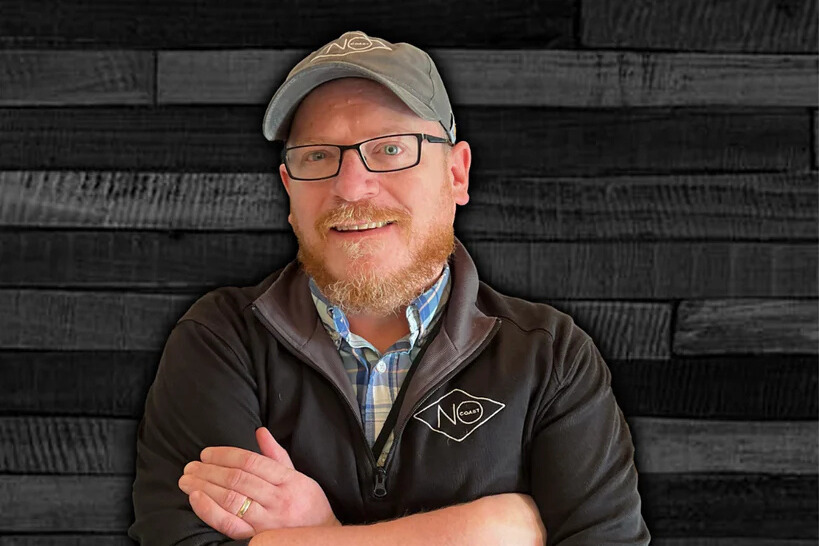
From a dorm room revelation to the rolling plains of Oscaloosa, Iowa — Jeremy Hunt has spent nearly a quarter century chasing the perfect pint. As head brewer at No Coast Beer Company, he brings that lifetime of experience to every can that leaves the building.
A Hobby That Got Wildly Out of Control
Jeremy Hunt did not set out to become a brewer. He went to college to discern the Catholic priesthood — a path that took an unexpected detour when he met his future wife, and an even more unexpected one when a fellow student named Thomas handed him an unlabeled beer in the hallway of what turned out to be a converted hotel dorm. “Why is there no label on this?” Jeremy remembers asking. “What are you actually giving me to drink?” The answer, delivered with all the casual confidence of a madman: “Oh, I made it.”
Thomas led Jeremy into his room, where fermentation vessels lined the closet and carboys soaked in the bathtub — completely against dormitory rules and, in Jeremy’s own words, the work of “an absolute lunatic.” But lunacy and wizardry, it turns out, look a lot alike from the outside. “I wanted my friends to think I was a wizard, too,” Jeremy says with a laugh, “because I didn’t know you could do this stuff at home.”
That moment, sometime around 1999 or 2000, set off an obsession. Jeremy devoured everything he could find on the subject at a time when the internet didn’t have a whole lot to say about home brewing. The hobby spiraled into formal training, and formal training spiraled into a 24-year professional career that would take him from small garage setups all the way to the legendary Dogfish Head Brewery in Delaware — one of the most influential craft breweries in American history. Today, he leads the brewing program at No Coast Beer Company in Oscaloosa, Iowa, a role he stepped into about a year and a half ago after relocating his wife and six children from Virginia. His oldest son now works alongside him in the cellar, transferring beers, kegging, and learning the trade the same way his father once did: by getting his boots dirty.
Where No Coast Came From — and What It Stands For
No Coast Beer Company was founded in 2016 as a passion project with unusually deep roots. Owner Brandon is the fourth-generation steward of Mahaska Bottling, a family company that dates back to 1889 and even holds a patent on an early hand pump and barrel attachment for carbonated beverages. The very ground the brewery sits on used to house the old well and Pepsi bottling facility for the region near Des Moines. There is, in other words, a very long tradition of beverages being made on this spot — and No Coast is simply the latest, and perhaps most creative, chapter.
Today, the company produces not just beer but also cold brew coffee and a rotating cast of other beverages, a breadth that reflects both the company’s heritage and its restless ambition. Jeremy describes this as tickling different parts of everyone’s brain — and that ethos carries directly into how he approaches the beer itself. Ask him to describe No Coast in one sentence, and he doesn’t reach for a slogan about flavor or style. Instead, he offers a philosophy: “The details matter.”
That phrase is borrowed, in spirit, from his time at Dogfish Head, where founder Sam Calagione was known for pushing brewers toward what he called being “off-centered” in what they produced — but completely meticulous about how they produced it. Jeremy has carried that lesson with him across every stop in his career, and it now defines No Coast’s approach to quality control. “If we’re not going to drink it, we’re not going to ask y’all to drink it,” he says flatly. “It has to pass our pretty stringent QA/QC.” For a brewer who admits he hardly drinks anymore — six kids and a smoker going at home has a way of reordering priorities — that bar is set by craft and conviction rather than personal indulgence.
The Beers: Old School Meets New School, and Everything in Between
No Coast operates on a 20-barrel production system alongside a one-barrel pilot system — a setup that gives Jeremy exactly the kind of flexibility he loves. The production side handles the core lineup with the precision and repeatability needed to build a brand. The pilot side, meanwhile, is where rules get bent and experiments come to life. It was on that pilot system, for instance, that the team brewed a 13.5% imperial stout loaded with cocoa nibs and hand-processed vanilla beans — a beer that was never intended for wide release, made purely because they wanted to. When it showed up at Brew Fest in Coralville, it flew off the table. One attendee came back eight times. Jeremy ended up giving him a hat.
Yoga Poser: Where Cascade Meets Citra
One of No Coast’s flagship beers is Yoga Poser, a pale ale that is itself a kind of time capsule under renovation. Originally released in 2016 as one of the brewery’s first beers, Jeremy came in and immediately saw potential to modernize it without erasing its identity. “Maybe we can make it a 2027 pale,” he says. The updated recipe — which he calls Yoga 2.0 internally — leans on a rare hop technique called cool pooling, where the wort is cooled after boiling and then charged with a blend of Cascade and Citra at around 170 to 175 degrees. At that temperature, the alpha acids aren’t isomerized into bitterness; instead, the process captures the purest aromatic expression of both hops — the old-school citrus punch of Cascade alongside the bright, tropical pop of Citra, with a smatter of Simcoe rounding things out. “Old school meets new school,” Jeremy says simply.
Midwest IPA: A Style Without a Coast
The first beer Jeremy designed after joining No Coast was the Midwest IPA, and its name is quietly a statement of identity. It is too fruit-forward to be a West Coast IPA. It is too brilliantly clear to be an East Coast hazy. So it is neither — it is a Midwest IPA, a style unto itself. A small addition of corn in the batch keeps the body lean and approachable, while the hop bill leans on some genuinely exciting and underutilized varietals. The star of the show is McKenzie, a hop from West Coast Hop Breeding that Jeremy describes as “an uber new-school sort of Centennial” — flinty, fruit-forward, and still relatively unknown. He rounds things out with Idaho Gem, Cashmere (a USDA-developed varietal funded through public agricultural research), and just enough Citra to keep things crowd-pleasing. The beer came together after a conversation with John Kimmich, the legendary brewer behind The Alchemist and its world-famous Heady Topper. Kimmich was kind enough to return Jeremy’s call with some insight on the McKenzie hop — a reminder that even after 24 years, the craft beer world is still built on people sharing knowledge.
Heritage: A German Recipe, an Iowa Flagship
If the Midwest IPA is Jeremy’s creative showcase, Heritage is his heart. An amber lager clocking in at 4.5% ABV, it is described by its brewer with an almost defiant simplicity: “There’s nothing funny about this beer. There’s nothing to hide behind. It’s an amber lager. It’s as advertised.” Heritage is lagered properly for six to eight weeks, following the German and Czech traditions that give the style its clean, precise character — and its origin story is one of the most charming in No Coast’s history.
Jeremy had no intention of brewing a lager when he arrived. Then, at a community festival at the Des Moines Zoo, he met a woman named Brigitta whose mother was from Germany and had passed along a family recipe. She offered to share it. “I have a recipe. Would you like to see it?” she asked. Jeremy looked it over — a rustic, amber-colored beer, warm and inviting — and found the inspiration he didn’t know he was looking for. Heritage was born from that recipe, and it has since become the brewery’s best-selling and arguably most important beer. “We have Brigitta to thank for Heritage,” Jeremy says. “I wouldn’t have brewed this beer if you hadn’t been so sweet and given us your mother’s beer recipe.”
Terpene Dreams: No Plants Were Harmed
On the more adventurous end of the spectrum sits Terpene Dreams, a pale ale that smells unmistakably of cannabis — without containing any. The beer uses a proprietary terpene extract from a California company that abstracts and maps the chemical compounds responsible for the aroma of specific cannabis strains. In this case, the strain is Pineapple Express, and the aromatic compounds — things like beta-caryophyllene from coriander, farnesene from hops, myrcene from botanicals — are reconstituted and added to what is otherwise a clean, crushable 5.5% pale ale. “This smells exactly like my 20s,” Jeremy says with a grin. “My pre-oil days.” No plants were harmed. All hops and fun.
Seasonals, Sourcing, and the Art of Being Nimble
No Coast’s seasonal calendar is built around the idea that the best beer for the moment is the beer that fits the moment. Oktoberfest arrives in September, brewed with all the care of a style Jeremy describes as his favorite both to make and to drink — though he jokes he wishes the calendar allowed for a December Fest, a May Fest, and a July Fest as well. Summer will bring a single malt, single hop citrus offering currently being workshopped under the name “Peel Good,” likely featuring tangerine and clementine. And winter means Pecan Sticky Bun, a pastry brown ale made with pecan rolls sourced from Yarmsma Bakery, just up the street. “There’s a local ingredient,” Jeremy notes with satisfaction. “Those go right in the mash tun.”
Sourcing, more broadly, is a topic Jeremy approaches with the practicality of someone who has spent decades navigating the realities of ingredient supply. He works with local farmers where possible — there is currently an experimental malt tonic project in collaboration with a nearby grain farmer — but he is clear-eyed about the limits of local sourcing when consistency is at stake. The best malting barley, he explains, comes from the Pacific Northwest or Canada. Hops grow best at latitude 42, in Idaho or across the Pacific Northwest, though he has found some surprisingly excellent Chinook from Michigan that he describes with genuine excitement. “That’s the terroir of beer,” he says. “I don’t want to sound as snoody as wine folks, but there is something to the growing regions.”
What’s Next: Trends, Tap Rooms, and Turning the Corner
Jeremy watches the broader craft beer landscape with the measured attention of someone who has seen trends come and go for two decades. Right now, he sees a market pulling in two distinct directions simultaneously: one crowd gravitating toward bold, high-ABV imperial beers with intense, layered flavors, and another crowd embracing low-ABV, clean, and crushable lagers — the “crispy boys,” in the industry parlance he delivers with barely concealed amusement. No Coast is positioned to serve both instincts, and Jeremy hints that an American light lager, done with the same meticulous attention the brewery brings to everything else, may be on the horizon. “We’re going to do it our way,” he says. “We’ve got a plan for it, and this stuff doesn’t come from shooting from the hip.”
As for the brewery’s longer-term ambitions, Jeremy speaks of a satellite tap room — a gathering place, a third space where the brand and its community can actually meet face to face. No Coast currently operates without a tap room, which means the team does much of its community building at festivals and sampling events. There is a certain irony, Jeremy notes, in the fact that people who live in Oscaloosa often don’t even know the brewery is there. A tap room would change that. “Just a place to celebrate with everybody,” he says. “That’s the goal, anyway.”
That spirit of celebration — quiet, unhurried, grounded in something real — is ultimately what Jeremy Hunt wants people to take away from No Coast Beer Company. Not a trend, not a gimmick, but a brewery that has done the work and will keep doing it. His parting philosophy is borrowed from a conversation with Boston Beer Company founder Jim Koch, back in 2006 when Jeremy was working at Redhook: drink less, drink better. “I think beer can be a good social lubricant. It could be fun because you’re trying new things. But keep it in moderation.” The details matter — from the first pour to the last.
To follow No Coast Beer Company, find them on Instagram and Facebook. To arrange a brewery tour, reach out directly via their website — Jeremy says he loves talking about beer, and he means it.

