An Iowa brewery proves that showing up, staying consistent, and knowing your customer beats any algorithm
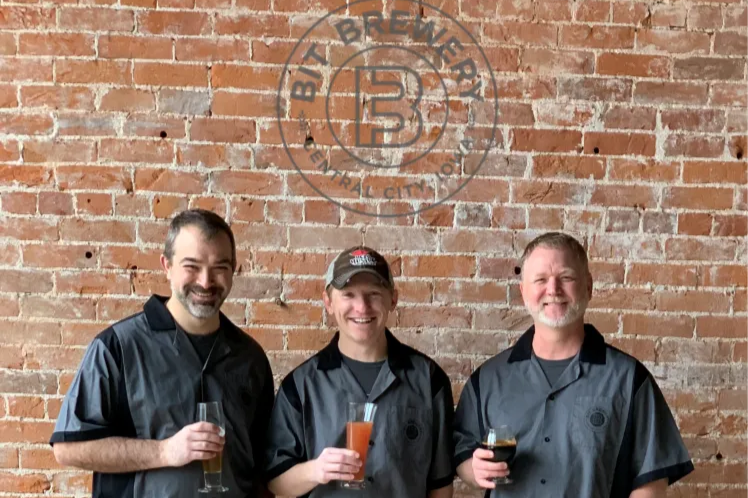
There are just over 1,285 people in Central City, Iowa — “and I don’t know, I think you count some as house pets in that,” jokes Scott Whitson, head brewer, managing partner, and co-owner of BIT Brewery. It’s the kind of self-deprecating line that tells you everything about how Whitson runs his business: no pretense, no corporate polish, just an old building, some live-edge wood, and two guys who like music and good beer.
- An Iowa brewery proves that showing up, staying consistent, and knowing your customer beats any algorithm
- Keeping the Brand Simple From Day One
- Throwing Everything at the Wall — On Purpose
- Learning What Actually Brings People Through the Door
- Turning Customers Into Collaborators
- Staying Rooted, Staying Honest
Six years in, BIT Brewery — the name stands for “Best in Three,” a nod to the trio of founders who opened it — has become one of the more talked-about small breweries in the Cedar Rapids area, despite having no marketing department, no ad budget to speak of, and a founder who openly admits he’s “not the best marketing person in the world.” And yet, on a recent conversation with Henry Nosek of Midwest Microbrew, Whitson laid out a marketing philosophy that has quietly worked: try everything, measure what actually brings people through the door, and don’t be afraid to admit when something doesn’t.
What follows is the story of how a small-town brewery built a marketing engine out of curiosity, consistency, and a stubborn refusal to fake anything.
Keeping the Brand Simple From Day One
When Whitson talks about how BIT Brewery defined its identity, he resists the idea that there was ever a grand strategy behind it. The brand grew out of who the founders actually were — three guys, not particularly complicated, who wanted a space that reflected their own taste. Whitson says he doesn’t really know how they defined the brand other than the fact that they’re “kind of old guys,” there were three of them, and they’re “not very complicated,” so they just went with it. The renovated old building, the live-edge wood, the music — none of it was manufactured for an audience. It was simply an honest extension of the owners.
That identity has proven durable, even through a significant change in ownership. Three years ago, one of the original three founders, Jeff, left the business due to changes in his personal life. Whitson describes it as an amicable exit — the kind where business partners remain friends, still golfing and grabbing beers together long after the paperwork is signed. Rather than using the transition as an opportunity to rebrand, Whitson and his remaining partner, Jason, kept the “Best in Three” name and the same understated identity intact. It’s a small but telling decision: the brand was never really about the number of owners. It was about a feeling, and that feeling didn’t need fixing.
This is, in many ways, the first lesson buried inside BIT’s marketing story — before you can figure out which channels to use, you need a brand identity simple enough to survive change. A complicated brand built on a specific founding gimmick can crumble the moment circumstances shift. A brand built on values — humility, craftsmanship, community — can absorb a lot more turbulence, the same lesson that’s carried New Glarus Brewing’s “Only in Wisconsin” strategy for decades.
Throwing Everything at the Wall — On Purpose
Ask Whitson what marketing channels have worked for BIT Brewery, and his answer is refreshingly honest: all of them, a little, and none of them perfectly. He explains that different channels reach different audiences, and that even though they sometimes overlap for beer lovers, at the end of the day a small business simply has to get its word out however it can.
That means BIT Brewery still shows up at community sampling events — six to eight over the summer, one in the winter — even though Whitson finds the process a little exhausting at this point in the brewery’s life. Six years in, he still runs into people at these events who have never heard of the place, a fact that clearly needles him a bit. It’s a useful reminder that even strong local word-of-mouth has limits, and that “everyone in town knows us” is often more aspiration than reality.
On social media, Whitson has developed a refreshingly unfussy approach. He’s aware of the conventional wisdom — post constantly, feed the algorithm — and he’s skeptical of it. He notes that Facebook posts reportedly reach only around two percent of a page’s audience — a figure that lines up with industry benchmarks showing organic reach hovering in the low single digits — and that while SEO experts push brands to post constantly to compensate, he doesn’t want to bombard his followers with the same repetitive content. Rather than grinding out daily content for its own sake, he aims for just a few posts a week across Facebook and Instagram, has largely abandoned X, and treats content creation as one task among many rather than a full-time obsession.
That’s not a throwaway comment — it’s central to how BIT markets itself. Whitson is the brewer, janitor, bookkeeper, payroll administrator, and repair man, all in the same week he’s also trying to be a marketer. He caps social media at two or three hours a week, a limit that forces discipline: whatever he posts has to count.
The brewery also leans on Untappd, the beer-discovery app, both as a digital menu and as an event calendar, and it hasn’t abandoned the analog world either — paper flyers still go up in the local bank, the post office, and other spots where the town’s residents naturally pass through. A weekly radio segment, roughly a minute long, lets Whitson talk about what’s new at the brewery, and clips from it get repurposed across YouTube, Facebook, and Instagram. Even TikTok gets an occasional appearance, usually at the urging of Whitson’s daughter, who serves as his de facto trend consultant. One video, made reluctantly at her insistence, pulled in 90,000 views — a number that surprised Whitson more than anyone. He admits he was skeptical going in, telling his daughter the video would make him look like an idiot, and was startled when it performed as well as it did.
The throughline across every channel is that nothing is chasing virality for its own sake. It’s a portfolio approach: cheap, low-effort touchpoints stacked on top of each other, none of them expected to carry the whole business alone.
Learning What Actually Brings People Through the Door
If there’s a single insight that defines BIT Brewery’s marketing philosophy, it’s this: don’t guess, ask. Whitson has built a simple but effective feedback loop directly into daily operations. Staff are trained to notice new faces, and whoever is on shift — Whitson or his partner Jason — makes a point of thanking first-time visitors and asking how they heard about the brewery. According to Whitson, social media and the local radio segment are, by far, what bring in the most new business outside of word of mouth, alongside a strong showing from Google searches for “breweries near me” and “restaurants near me,” with the restaurant search actually ranking a bit higher for them — part of a broader trend of explosive growth in “near me” search behavior that small businesses everywhere are learning to capture. It’s a similar organic-discovery pattern to the one that carried another Iowa brewery, Toppling Goliath, from a homebrew kit to national recognition.
That kind of grassroots data collection also produced one of the more instructive failures in BIT’s marketing history. A few years back, Whitson paid to wrap the golf carts at a nearby baseball and softball complex that draws roughly 170,000 individual visitors each season — a genuinely staggering figure for a small-town facility. On paper, it looked like an obvious win: massive foot traffic, a captive audience, a visible logo.
In practice, it flopped. Whitson says he never once heard anyone mention seeing the logo on the carts — even customers who’d come directly from that complex said they’d simply searched “restaurants near me” or “breweries near me” on Google rather than noticing the branding. For a $2,500 annual spend, that stung. He jokes that the real lesson was that people don’t look at golf carts much at a ballpark, but the deeper lesson is more useful: without a way to verify whether an expensive tactic is driving traffic, it’s easy to keep funding something that isn’t working. BIT’s habit of simply asking new customers how they found the place turned an ambiguous marketing spend into a clear, if disappointing, data point.
That same instinct toward measurement shows up in how Whitson thinks about live events. He tracks attendance at music nights closely enough to know that Friday shows tend to perform better once football season ends, since Friday nights otherwise compete with high school football games. It’s a small, almost folksy piece of data analysis, but it’s exactly the kind of granular, locally-specific insight that a national marketing playbook would never surface — and exactly the kind of insight that only comes from paying close attention to your own community over years, not quarters.
Turning Customers Into Collaborators
Perhaps the most distinctive piece of BIT Brewery’s marketing mix isn’t a channel at all — it’s a program. Under what Whitson calls the “brewer in training” experience, customers pay a modest fee to help design and physically brew their own custom beer alongside him: choosing a style, explaining why they like it, and then spending roughly eight hours in the brewery milling grain, working the mash tun, and measuring out brewing salts. Whitson says participants come away with a genuine appreciation for what brewing actually involves, since most people assume he simply stands around drinking beer and pushing buttons — which, he’s quick to point out, is not quite the reality.
When the custom beer is finished, the customer gets to choose the release occasion — an anniversary, a birthday, even an Iowa–Iowa State football game, in one memorable case — and invite friends and family to celebrate. Whitson pours the first pint himself, throws in a free mug of beer, and enrolls the participant in the brewery’s mug club as a bonus. The result, more often than not, is a small party built entirely around introducing new people to the taproom.
Whitson is unusually direct about why this program works as marketing: it’s rare. He believes most breweries avoid offering this kind of hands-on experience because of liability concerns, and while BIT has been fortunate to avoid any incidents, he takes safety extremely seriously, warning participants firmly away from anything that could actually hurt them. The novelty is the point — nobody else in the region is doing it, which makes it inherently more talkable than another flyer or Facebook post ever could be, echoing how One Well Brewing in Kalamazoo turned an unusual in-house experience into its own word-of-mouth engine.
The same philosophy extends to BIT’s community brewing partnerships. Whitson has brewed custom beers for the local American Legion post, a nearby golf course, and other community organizations, each project generating its own small burst of word-of-mouth exposure — a community-first approach not unlike the one that turned Bent Paddle Brewing into a cornerstone of its Duluth neighborhood. He’s candid that margins on kegs sold to outside partners are thin compared to larger regional operations running much bigger systems. But he views the exercise through a marketing lens rather than a wholesale-profit one: every keg sold elsewhere is an invitation back to the taproom, where margins — and the relationship with the customer — are strongest.
Staying Rooted, Staying Honest
Ask Whitson how BIT Brewery leans into its Midwest identity, and he doesn’t reach for a tagline. He talks instead about small, personal habits — holding doors for older customers, helping a stranger return a shopping cart, wearing BIT-branded clothing wherever he goes — gestures he freely admits might not move the needle for everyone, but that he believes matter to some people. It’s less a marketing tactic than a worldview, and Whitson is careful to note that it isn’t performance. It’s simply how he and his partner choose to operate, in the taproom and out of it.
That same instinct for authenticity shapes how he handles customer feedback. Rather than settling for polite reassurances that a visit was “fine,” Whitson makes a habit of pressing further, telling guests directly that if the beer or food ever falls short, he needs to hear about it so he can fix it. It’s a small gesture, but one he believes customers pick up on — proof that the friendliness isn’t a script.
Looking ahead, Whitson isn’t chasing the next big platform so much as staying alert to how customer behavior keeps shifting — from MySpace to Facebook to whatever comes next, and now to AI-driven search — a challenge that Minneapolis’s Indeed Brewing has faced over its own decade-plus of staying relevant. He’s cautiously optimistic about AI’s practical uses, like generating graphics or pulling data from equipment reports, but wary of how easily it can spread inaccurate information about a business it’s never visited. His answer isn’t to chase the newest tool — it’s to stay aware, keep showing up in ways that have already proven to work, and keep asking every new customer the same simple question: how did you hear about us?
In an industry full of competing advice about SEO, ad spend, and platform algorithms, BIT Brewery’s marketing success ultimately rests on something far less complicated: a consistent brand, a handful of low-cost channels used without pretense, a willingness to admit when an expensive idea fails, and a genuine curiosity about where the next customer through the door actually came from. It’s not a glamorous playbook. But six years and roughly 150 mug club members later, it’s one that works.
For more conversations like this one, explore Midwest Microbrew’s full library of brewmaster interviews from across the region.