Table of contents
The story starts with a beer that wasn’t supposed to leave Vermont.
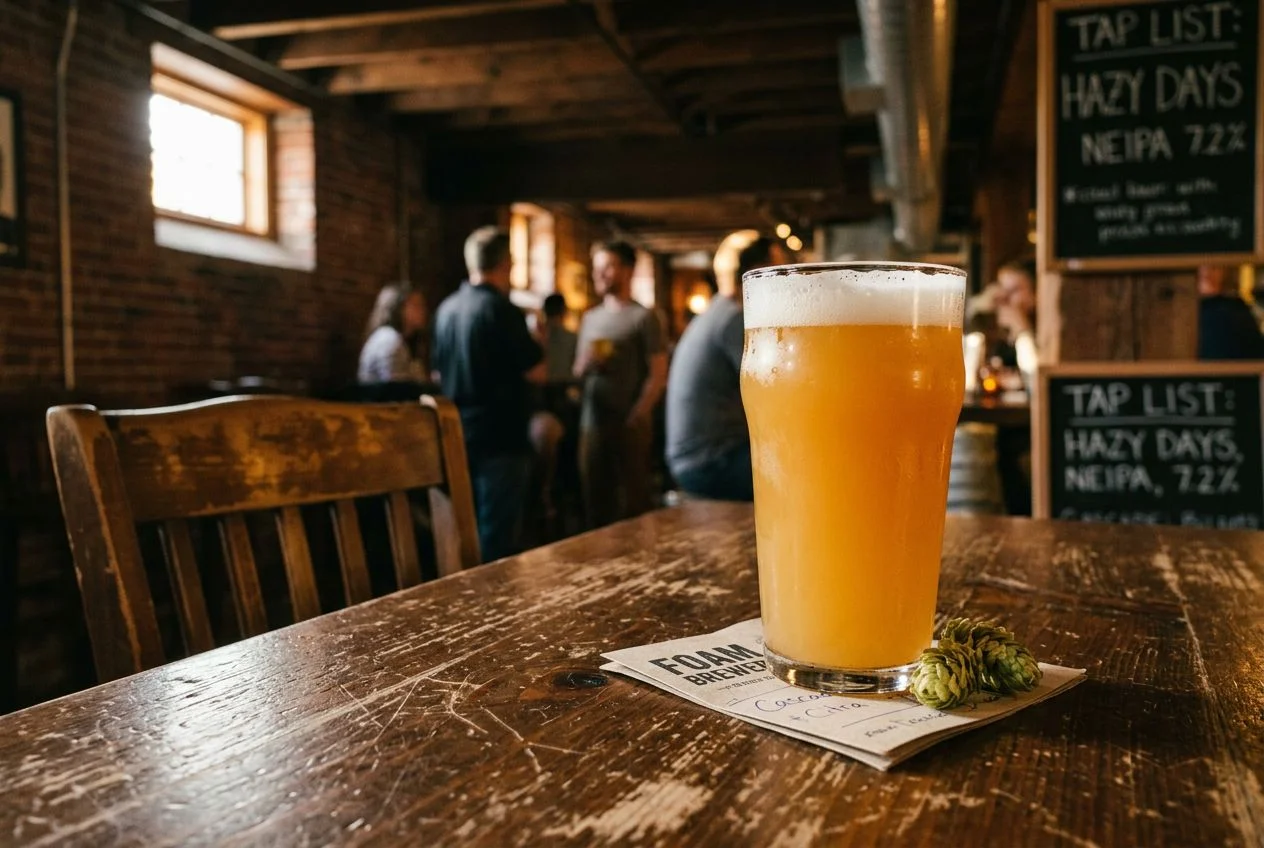
In 2003, John Kimmich and his wife Jen opened The Alchemist, a 60-seat brewpub with a seven-barrel basement brewery in Waterbury, Vermont, in a building that had once been the town’s original post office. Kimmich brewed a double IPA called Heady Topper and dry-hopped it aggressively. The late-addition and dry-hop additions were so heavy that the beer came out cloudy, almost opaque. It had a murky, golden-orange haze that looked like something had gone wrong. It hadn’t. The haze came largely from hop compounds: polyphenols from the hops binding with proteins from the grain, along with other hop material, all left suspended in the beer because Kimmich neither filtered nor pasteurized it. The flavor was unlike anything on the market: juicy, tropical, and driven by hop aroma, with a bitterness the brewery describes as smooth rather than harsh.
For years, Heady Topper was a Vermont secret. Then it wasn’t. And the history of the hazy IPA really begins with what happened when the rest of the country caught up to a beer that had been available only on draft in a Waterbury brewpub for nearly eight years.
The history of the hazy IPA starts with a typo

The Brewers Association’s beer style guidelines had no category for a hazy IPA. Heady Topper was a double IPA by recipe, but it looked wrong. It was hazy when clarity was a point of pride, and it was unfiltered and unpasteurized when both were common practice. Kimmich has said that in the first two years Heady Topper was in cans, vocal critics online relentlessly attacked it, calling it “ugly,” and that it took years to convince people that haze was okay. He kept brewing it anyway.
That’s the first honest admission in this story: the hazy IPA wasn’t planned. Kimmich has said the haze was never the goal; it was a byproduct of how he got the flavors he wanted from an unfiltered, unpasteurized beer. A lot of people still thought it was a mistake. Clarity was the mark of a well-made beer in the early 2000s. Brewers fined with isinglass or gelatin, filtered, and chased a bright, clean pour. A cloudy IPA read as unfinished.
What Kimmich understood, a lesson he credits to his mentor Greg Noonan, the founder of the Vermont Pub and Brewery, and what the industry took years to accept, was that the compounds creating the haze were tied up with the compounds carrying the flavor and aroma. Filter them out and you filter out the point. The style wasn’t a flaw. It was a trade-off, and he’d chosen flavor over appearance.
How did hazy IPA leave Vermont?
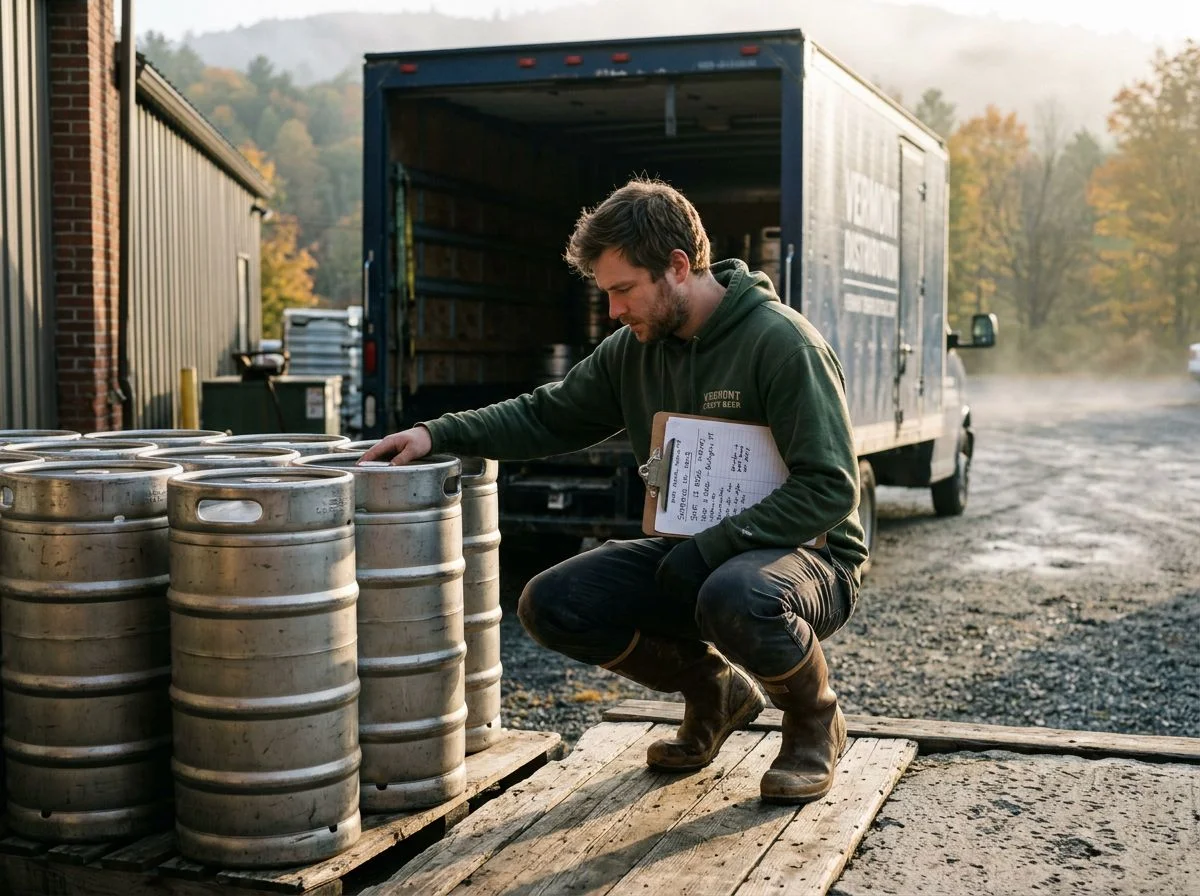
In August 2011, Tropical Storm Irene flooded The Alchemist’s Waterbury brewpub, and the Kimmichs decided not to reopen it. They were just starting up a production brewery and cannery elsewhere in Waterbury, and Kimmich has said the first cans of Heady Topper came off that line two days after the storm. A second brewery and visitor center followed in Stowe in 2016. In the years in between, a small network of Vermont brewers became the reference points for what people started calling “Vermont-style” IPA. There was Shaun Hill at Hill Farmstead in Greensboro Bend, and Sean Lawson’s Lawson’s Finest Liquids, then brewing small batches in Warren (it opened a larger brewery in nearby Waitsfield in 2018). Hill Farmstead’s Edward and Susan, Lawson’s Sip of Sunshine, and Heady Topper formed a loose canon. If you wanted to understand the style, you drove to Vermont and stood in line.
The lines were the tell. Heady Topper was sold in cans with a label telling drinkers to drink it straight from the can rather than a glass, Kimmich’s way of getting the beer to customers at its freshest. It was a practical move that also became a kind of branding. People traded cans like currency. A beer the brewery kept close to home became a beer people drove for.
Then the style moved. Tree House Brewing started in 2011 in a small barn in Brimfield, Massachusetts, and moved to a larger space in Monson in 2013. Its Julius, a hazy IPA brewed with a closely guarded blend of hops, became the next pilgrimage beer. Trillium opened in Boston’s Fort Point neighborhood in 2013. Other Half opened in Brooklyn in 2014. Monkish, which had opened in Torrance, California, in 2012 as a Belgian-focused brewery, released its first IPA in 2016, a collaboration with Other Half, and went on to specialize in hazy IPAs. By the middle of the decade, the hazy IPA had a name, a look, and a growing national audience. The breweries making it were almost all small, young, and selling out of cans on release days.
What hazy means inside the tank

The process behind the style is less mysterious than the name suggests. A hazy IPA is typically brewed with a grist that includes a meaningful share of oats or unmalted wheat. Both contribute proteins that stay in suspension and build body. The beer is dry-hopped at high rates, often in multiple additions. Sometimes it’s dry-hopped during active fermentation, a practice meant to encourage biotransformation, the yeast-driven conversion of hop compounds into new aromatic ones. (How much the timing matters is still debated; some brewers now put most of the dry hop in after fermentation.) It’s not filtered. It’s often fermented with an English-derived yeast strain such as London Ale III, which has become synonymous with the style. That strain is actually rated highly flocculent, so the haze doesn’t come from poor settling; it comes mainly from hop polyphenols reacting with grain proteins.
The bitterness is dialed back. Where a West Coast IPA might land at 60 to 70 IBUs, a hazy IPA often sits closer to 30 to 50 (the BJCP guidelines allow 25 to 60). The hop character is carried by aroma rather than bite. The result is a beer that drinks softer than its ABV suggests. That’s part of why the style caught on with people who’d never loved bitter beer.
The style also created a problem the industry is still working through: haze can be faked, or at least people suspect it can. NPR reported in 2017 on rumors of brewers adding flour or applesauce to get the look without the process. None of the brewers it spoke with admitted to doing it, though Kimmich said he knows for a fact that some do. In March 2018, the Brewers Association added three “Juicy or Hazy” categories (pale ale, IPA, and double IPA) to its style guidelines, giving the style an official definition and its own categories at the Great American Beer Festival.
The Midwest version of hazy IPA history
The hazy IPA didn’t arrive in the Midwest as a copy. It arrived as a local answer.
Toppling Goliath in Decorah, Iowa, had already built a reputation for hop-forward beer with Pseudo Sue, a pale ale named for a T. rex skeleton at the Field Museum in Chicago. When the brewery released King Sue, a double IPA in the hazy mold, it became one of the most sought-after Midwest beers of the late 2010s. Decorah became a destination the way Waterbury had been. Iowa, improbably, had a pilgrimage beer.
In Minnesota, Surly Brewing’s Axe Man (originally Todd the Axe Man), a Citra-and-Mosaic IPA with a hint of haze that the brewery originally billed as West Coast style, gave the Twin Cities a hop-forward reference point. In Wisconsin, Brewing Projekt in Eau Claire built a following on heavily fruited and heavily hopped beers that leaned into the style’s soft, juicy end. In Illinois, Hop Butcher for the World was founded in 2014 and began selling beer in 2015, brewing at other Chicago-area breweries and self-distributing hop-forward IPAs to local retailers. Its steady stream of different cans turned Chicago beer shelves into a rotating scavenger hunt; it didn’t open its own taproom until 2022. In Michigan, Old Nation’s M-43, a hazy IPA brewed in Williamston, became one of the state’s most recognizable beers and, for a while, one of its hardest to keep in stock.
The pattern repeated: a small brewery, a flagship hazy, a line out the door. The style was portable in a way that West Coast IPA hadn’t been, because it rewarded local brewing rather than a single regional signature.
What the hazy IPA backlash revealed
By the late 2010s, the hazy IPA had a backlash. Brewers who’d spent careers chasing clarity were openly skeptical. Some drinkers found the style samey: soft, juicy, low-bitterness beers that blurred together on a tap list. The word “milkshake” started attaching to sweeter, thicker versions, and the line between a hazy IPA and a dessert beer got fuzzy.
There was a real critique underneath the noise. A style that rewards heavy dry-hopping is a style that rewards access to hops. Demand for a handful of popular aroma varieties, Citra, Mosaic and Galaxy among them, ran ahead of supply, and smaller breweries without long-term contracts had to buy on the spot market at higher prices or brew around shortages. How real the “hop shortage” of the mid-to-late 2010s was is disputed: trade coverage at the time described it as partly a perception created by over-contracting, and prices later eased. For breweries without contracts, though, the squeeze on specific varieties was real.
The style also exposed a tension in craft beer’s self-image. For two decades, the industry had sold itself on education and connoisseurship: IBUs, clarity, technical precision. The hazy IPA was a beer that asked you to stop looking at it and just drink it. Some people loved that. Some people thought it was a step backward.
Both reactions were fair. The style isn’t better or worse than a clean West Coast IPA; it’s a different set of choices. The honest version of the history is that the hazy IPA won commercially while remaining genuinely divisive among brewers. That’s probably how it should be.
What the style left behind
The hazy IPA’s biggest legacy might be the way it changed what brewers were willing to do with hops. Late-addition and dry-hop techniques that were once niche are now standard across styles. The idea that a beer could be defined by aroma rather than bitterness moved into pale ales, pilsners, and even lagers. The “hoppy lager” boom of the last few years owes something to the hazy IPA’s proof that drinkers would pay for aroma.
It also changed how breweries sell beer. The can-release model (a limited run, announced on social media, sold at the brewery door) was refined by hazy IPA breweries. It’s now standard practice across the Midwest. If you’ve ever set an alarm for a Saturday morning can drop at a local brewery, you’re participating in a system the hazy IPA helped build.
And it changed the map. Waterbury, Vermont; Brimfield and Monson, Massachusetts; Decorah, Iowa; Williamston, Michigan; Eau Claire, Wisconsin. The history of the hazy IPA is a history of small towns becoming beer destinations, one flagship release at a time.
The pint in front of you

The next time a hazy IPA lands on the bar in front of you, opaque, soft, smelling like a fruit stand, it’s worth remembering that it started as a beer some people called ugly. Kimmich kept brewing it. The lines formed. The style spread. The industry argued about it. And somewhere in that argument, a generation of brewers learned something. The rules about what a beer is supposed to look like matter less than what it’s supposed to taste like.
That’s not a bad thing to raise a glass to. Even if you drink it from the can.