- How a Michigan Native and Culinary Graduate Built One of Chicago's Most Beloved Brewpubs
- A Culinary Foundation Meets Craft Beer Obsession
- The Beers That Built a Reputation
- Beyond the Flagships: Seasonal Innovation
- More Than a Taproom: Building Community
- Chicago's Craft Beer Brotherhood
- Looking Forward: Trends and Traditions
- The Essential Old Irving Experience
How a Michigan Native and Culinary Graduate Built One of Chicago’s Most Beloved Brewpubs
The journey from Michelin-starred kitchens to brewing award-winning hazy IPAs might seem unconventional, but for Trevor Rose-Hamblin, co-founder and head brewer of Old Irving Brewing in Chicago, the path made perfect sense. What started as a passion project fueled by a love of Michigan craft beer has evolved into one of Chicago’s most community-oriented brewpubs, where wood-fired food meets World Beer Cup gold medals and neighborhood block parties.
Located just steps from the Blue Line in Chicago’s Old Irving Park neighborhood, the brewery has spent nearly a decade cultivating something rare in the craft beer world: genuine community. As Rose-Hamblin approaches the brewery’s tenth anniversary in 2026, he reflects on the winding road that brought him from culinary school to the brewhouse.
A Culinary Foundation Meets Craft Beer Obsession
Rose-Hamblin’s beer education began long before he ever thought about opening a brewery. Growing up in Michigan during the early days of the state’s craft beer revolution, he developed a palate for beers like Oberon, Two Hearted, and Dragon’s Milk. But his professional ambitions initially pointed toward the kitchen.
“I moved out to Chicago back in 2008 to attend Kendall College School of Culinary Arts,” Rose-Hamblin recalls. “I worked for some really great restaurants, but still had this love for beer and brewing. So I started brewing a lot on my own.”
That thirst for brewing knowledge led him to knock on the back doors of Chicago breweries, seeking any opportunity to learn. Pipeworks, DryHop, and Flossmoor Station all played roles in his informal education. At Flossmoor Station, he apprenticed under Bujorn Johnson, who now serves as lead brewer at Goose Island.
“I had pretty much spent all my money on culinary school, and that was expensive,” he explains. “There wasn’t much debt left I could go into.”
Rose-Hamblin’s culinary career continued to advance. He worked his way up from cooking on the line at Moto, a pioneering molecular gastronomy restaurant, eventually managing both Moto and its sister restaurant. It was during this time that the brewpub concept began to crystallize.
“At the time there wasn’t a ton of brewpubs in the city. You had Revolution, Goose Island, and Piece, but that was about it. I was like, we need something that has more focus on the food.”
The restaurant’s owner agreed, and when they met a neighbor interested in opening a brewery, the pieces fell into place. Old Irving Brewing opened in 2016 with a clear mission: quality in everything, from service to food to beer.
The Beers That Built a Reputation
Walk into Old Irving Brewing’s taproom, and you’ll find a lineup that reflects Rose-Hamblin’s evolution as a brewer. The core beers tell the story of a brewery that honors tradition while embracing innovation.
Dela: A Tribute to Neighborhood History
The very first beer brewed on Old Irving’s system was Dela, a Kölsch-style ale that remains a cornerstone of the lineup. Named after the first daughter of Old Irving Park’s founder, the beer represents everything Rose-Hamblin wanted to create for the neighborhood.
“I just really enjoyed a Kölsch beer, and I knew there wasn’t a lot of them on the market when we first opened,” he says. “I was really excited after I brewed my first one homebrewing and wanted to grow that style and do some education with the general public.”
The light, crisp, easy-drinking ale has become what Rose-Hamblin calls “a working person’s beer,” beloved by regulars who belly up to the bar knowing they can enjoy several pints without the commitment of higher-ABV options. Dela earned silver at the James Beard Foundation Awards in 2021, validating what neighborhood drinkers already knew.
Sentinel: The Original Flagship
Before hazy IPAs dominated craft beer menus, Old Irving‘s flagship was Sentinel, a classic Midwest-style IPA with more malt backbone than its West Coast counterparts. Built on Centennial hops with Mosaic and Citra providing aromatic complexity, the beer was named for its role as the brewery’s protector.
“I kind of called it the protector of our brewery, like the guards would have done in Rome,” Rose-Hamblin explains. “We wanted to make sure we had something that could really sell a lot of beer and turn heads.”
Beezer: The Game Changer
Then came Beezer, and everything changed.
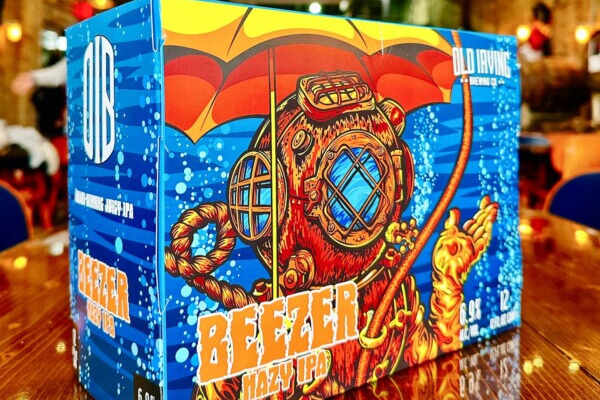
The hazy IPA that would eventually win gold at the Great American Beer Festival started as “Trendy with an I,” a tongue-in-cheek name reflecting Rose-Hamblin’s initial resistance to the style. “I was kind of a little bit up my own butt before I even knew what I was doing, about styles and stuff,” he admits with a laugh.
An investor who loved hazy IPAs shared some with Rose-Hamblin, sparking a two-year period of tinkering and refinement. The result was Beezer, named after an old-timey term for the nose, a nod to the intense hop aromatics that define the style.
“I thought that was cool since you use so much aroma hops. Also, it’s a term that you never hear, so you’ll remember it.”
The beer features 40% wheat for a velvety mouthfeel and comes in at 6.9% ABV. When Beezer won gold at the 2019 Great American Beer Festival, the brewery had just fifteen barrels in the fermenter. Growth became inevitable.
“Things moved fast, and we had to grow. We were doing some contract brewing, but eventually we did decide to open up a second spot to keep up with the brewing.”
Beezer added another gold medal at the 2023 World Beer Cup and another at the James Beard Foundation Awards, cementing Old Irving’s reputation as one of Chicago’s premier IPA producers.
Beyond the Flagships: Seasonal Innovation
Rose-Hamblin’s culinary background shines through in Old Irving’s approach to seasonal beers. The brewery releases approximately five lagers throughout the year, each designed to complement Chicago’s distinct seasons.
“We do have seasons here in Chicago. It’s nice to have beers that kind of vibe with that,” he notes. “You can’t drink a pumpkin beer in January.”
The rotation includes Ursa Major (Baltic porter), Goat Destroyer (Maibock), Sona (Helles), an Oktoberfest, and Life’s Blood (dark bock for Halloween). A sour series called Cushy rotates different fruits throughout the year.
Krampus Cookies: The Annual Event
Perhaps no beer generates more anticipation than Krampus Cookies, a 15% barrel-aged stout released each holiday season.
“Santa’s supposed to get milk and cookies. Krampus gets milk and cookies in the shape of a 15% beer that’s been aged in bourbon barrels.”
The brewery creates variants each year and hosts a Krampus Market featuring vendors in what Rose-Hamblin describes as an “anti-Christkindlmarket with spooky stuff.” The event has become a cornerstone of community programming.
Pushing Boundaries with Barrels
Rose-Hamblin’s experimental side emerges in the brewery’s barrel program. A recent collaboration with Revolution Brewing incorporated French oak staves from Creative Oak in California, each toasted differently to impart flavors ranging from marshmallow to crème brûlée.
One element involves oak from France’s prestigious wine-growing regions. “It was cool to be able to get some oak from that forest, especially given the history with restaurants and wine,” Rose-Hamblin says.
More Than a Taproom: Building Community
What sets Old Irving Brewing apart from many craft breweries isn’t just the beer or the wood-fired food, it’s the genuine sense of community that permeates every aspect of the operation.
“When you’re around for ten years, you get so connected that they’re almost a part of your daily life, some of these guests,” Rose-Hamblin reflects. “Unfortunately, we’ve had some really beautiful things like weddings that we’ve been invited to, and unfortunately some funerals. You just get so ingrained in the community that you are truly a part of it.”
The brewery donates beer to neighborhood block parties with an “almost no questions asked” policy. They support St. Edward’s Church nearby and participate in countless local fundraisers.
“We want to be your beer. We want to be there for your celebration, even if we’re not going to be there physically.”
A Culture of Creativity
Inside the brewery, that community-minded approach manifests as a collaborative creative culture. The cocktail program, led by General Manager Joshua Blevens, exemplifies this philosophy. Rather than having one person dictate the menu, every employee contributes ideas.
“Not every place is like that,” Rose-Hamblin emphasizes. “There’s not a lot of places that are going to say, ‘Hey, we want your input or feedback on the beer, the cocktail.’ We want everyone involved because we know it can always be better.”
This inclusive approach, Rose-Hamblin believes, contributes to staff retention and overall success. “I think more places would have a lot less turnover and a lot more success if they had that kind of culture, because it’s just the kind of people that attracts.”
Chicago’s Craft Beer Brotherhood
The competitive landscape of Chicago craft beer might seem cutthroat, but Rose-Hamblin describes something closer to a brotherhood. The relationship between Old Irving and neighboring Alarmist Brewing illustrates this dynamic. When the hazy IPA category debuted at GABF in 2018, Alarmist won gold. The following year, Old Irving took the prize.
“We’re very close to one another. I was very good friends with Aaron, the head brewer there, and we were sharing a lot of notes. Our beers were pretty similar at the end, with some really big shining differences because we both had our individual philosophies, but we kind of got better together.”
Rose-Hamblin also points to his relationship with Marty Scott of Revolution Brewing, whose barrel-aging program he considers among the best in America. Despite the massive difference in scale, Scott regularly visits to share knowledge and collaborate.
“The amount of beer that we make is probably what they waste in a month, and he’s willing to come by and give me pointers and brew with me. There’s a big part of community here in Chicago.”
Looking Forward: Trends and Traditions
After nearly a decade in the industry, Rose-Hamblin has watched craft beer evolve. The current trend toward lower ABV beers and smaller serving sizes reflects consumers becoming more health-conscious and facing competition from ready-to-drink cocktails and THC beverages.
“I think a lot of us are going back to crispy, easy-drinking lagers. I think you’re going to see a lot of people going back to twelve-ounce cans because I don’t know if people always want a pint of something.”
Non-alcoholic beer has also proven more than a passing trend. Despite the challenges facing craft beer, Rose-Hamblin remains optimistic. “I am excited by the future of beer. There’s a lot of cool stuff that’s going to come up and change.”
The Essential Old Irving Experience
For first-time visitors, Rose-Hamblin offers clear recommendations: start with a pint of Beezer, the award-winner that put the brewery on the map. Follow it with one of Joshua’s cocktails. And from the kitchen, order the octopus.
“We braise and then wood-fire this octopus with poached and then fried potatoes. I don’t think you would expect octopus out of a brewpub.”
The brewery opens at noon every day and sits directly on the Blue Line, making it an easy stop for travelers heading to or from O’Hare. “You can literally get on there, bring your roller bag, we got a place for you to keep it.”
For Rose-Hamblin, approaching the ten-year mark feels both like an eternity and no time at all. What began as a dream to merge his culinary training with his love of craft beer has become something larger: a neighborhood institution where award-winning beer meets genuine hospitality, where employees contribute to the creative process, and where regulars become family.
“I always call it the big little town,” he says of Chicago. At Old Irving Brewing, that small-town feeling persists in the heart of a major city, one Beezer at a time.