
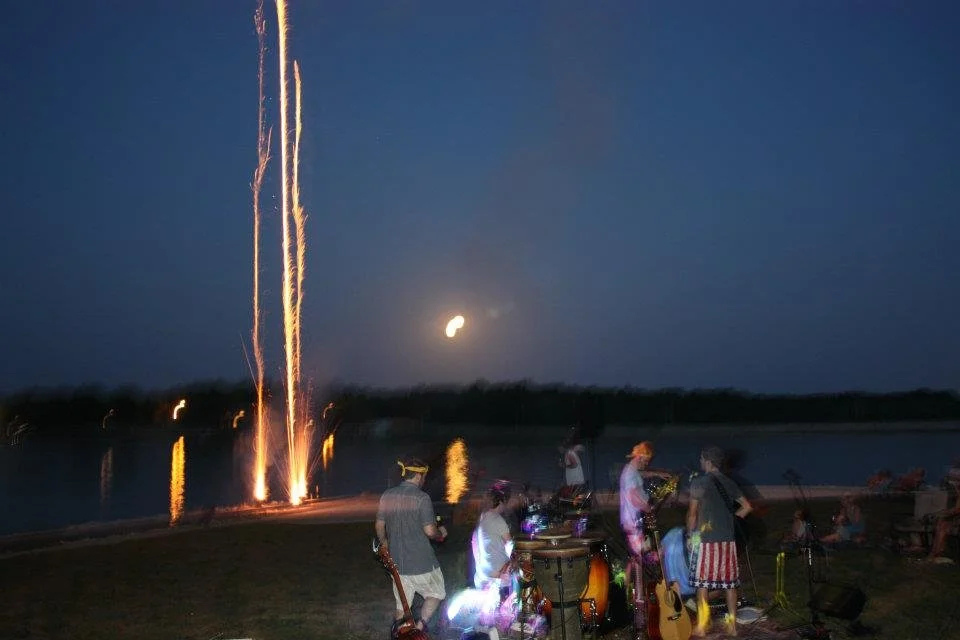
Logboat Brewing began as a punchline: three friends who played music together and slowly admitted that the beer was better than the band. A little over a decade later, that joke has grown into a 30-barrel production brewery in Columbia, Missouri, with cans on shelves from St. Louis to Kansas City to the Ozarks, a sprawling sun-soaked yard, and a second location on the way.
To hear how it happened, Henry sat down with Josh Rein, Logboat’s brewmaster, for an episode of the Midwest Microbrew podcast. Rein is 43, started homebrewing in 2003, and has a plain-spoken way of explaining what makes a good beer. What follows is the story of how Logboat came to be, what it pours today, and where it is headed next, told largely in his words.
How Logboat Began: Three Friends and a Better Idea
Logboat brewed its first batch on Fay Street in March 2014, a crisp, hoppy pale ale the brewery named Ignition Sequence as a countdown to launch. Behind it were co-founders Tyson Hunt, Judson Ball and Andrew Sharp, who had spent years making beer and music together.
Rein describes the origin plainly. Logboat was “the brainchild of three close friends that had some home brewing experience and played music together.” Eventually the verdict came in. “They realized the beer was better than the music,” he says, and they decided to build a brewery in Columbia.
The timing made sense. Back then, Rein recalls, “there wasn’t but a couple pubs in town,” and the founders were thinking bigger than a single taproom. They wanted a distribution brewery, one whose beer would travel well beyond its own walls. Then they needed a brewer.
The Homebrewer Who Got the Call
Rein was already working at a couple of those pubs. He had started homebrewing in 2003 and, after years of learning, landed his first professional brewing job in 2009. As for how he and the founders connected, even he is not sure who called whom: “I got a hold of them or they got a hold of me.”
The founders were friends “really passionate about starting a business that could bring community together here in Columbia.”
Rein sees his own path as part of a larger generational story. At 43, he says, there are “a lot of brewers like me” who cut their teeth in the early 2000s and 2010s, starting out as homebrewers during what he calls “the heyday of it all.”
A Philosophy Built on Balance
What sets Logboat apart in Columbia starts with how the beer is conceived. Only a few breweries operate in town, and each has found its own niche. Logboat’s was a commitment to distribution from the very beginning, paired with a clear creed. “My philosophy on beer is balanced beer, no matter the flavor, no matter the beer,” Rein says. “Always looking for balance.”
Drinkability, Defined
“Drinkability” is a term he says Bud Light took over years ago, and he still laughs about it. But he insists it is a true statement: a good beer should leave you “wanting to have more than one of them.”
That approach has traveled well. Logboat’s beer reached St. Louis in 2015 and Kansas City in 2016, and for the past three years or so it has been available in southern Missouri too, which puts it in every corner of the state. The Columbia Chamber of Commerce noticed early, naming the brewery its 2016 Small Business of the Year.
Keep Your Paddle Wet
When Henry asked for Logboat in a single sentence, Rein paused. “Why am I stumped?” he asked. His first instinct was to point at the staff: “Logboat is the people who make this happen.”
The closest he came was the brewery’s motto, “keep your paddle wet.” The phrase nods to floating the beautiful streams of the Ozarks, a logboat being an old name for a dugout canoe, but Rein says it is less about the river than the attitude: “just staying active and adventure.” At the brewery, that means “building community around a really wonderful product that’s high quality.”
The Lineup: What Logboat Pours Today
Snapper IPA: The Flagship
Snapper IPA is the brewery’s biggest seller by a wide margin. “There’s a reason why it is forty five percent of our production,” Rein says. It is a West Coast-style American IPA with big notes of peach, pear and citrus from El Dorado and Centennial hops, backed by resinous Columbus and Chinook. True to Rein’s philosophy, it is “not super bitter” but still very much an American IPA.
Everyday Ales and Wheat Beers
Lookout, the year-round pale ale, is built in the old-school style with Cascade hops and caramel malt, and Rein calls it “properly balanced.” Chiphead is a ginger wheat beer made with fresh ginger and lemon zest. High Tide, a wheat beer brewed with orange zest, may be the real crowd favorite: Rein says sales data shows it is probably the most popular beer in the taproom.
The Award Winners
Rein’s personal favorite is Mammoot, an English dark mild layered with chocolate malt, dark caramel malts and brown malt. A mild is a low-strength, malt-forward style, and this one “tastes like breakfast in a glass.” It has been Logboat’s most awarded beer in national competitions, and fellow brewers seem to love it. “Every brewer I’ve ever met and served it to, they go, ‘This is the jam,'” he says.
Dark Matter, a brown porter, took four medals this past year in national and state competitions, including at the Great American Beer Festival and the Best of Craft Beer Awards.
Lagers for Everyone
On the lager side, Bobber is a year-round beer Logboat calls a Missouri Pale Lager, in the spirit of a Dortmunder, a crisp, golden German style with a bit more body than a pilsner. Light Lager, made with 30 percent corn, is exactly as approachable as it sounds. During a recent Dad’s Weekend in Columbia, the brewery poured nearly three barrels of it, draining a six-barrel serving tank about twice as fast as normal. “It’s pretty dang tasty,” Rein says.
In recent years, Logboat has also expanded its packaged lagers to include a Helles, a Mexican lager and an Oktoberfest that now hits shelves around August, thanks to what Rein calls “the Oktoberfest creep.”
Experiments, Barrels, and the Portal Series
Margaritas and Cherries
Rein’s most unusual project may be a pale ale brewed with lime zest and aged in tequila barrels, an attempt to rework a margarita into a beer. “Can we do this?” he remembers asking. Was it great? “I don’t know,” he admits. “Not everything hits.”
Another experiment involved filling wine barrels with Rainier cherries, topping them off with a Belgian golden ale, and letting everything sit for six months. Getting the beer back out was messy, but the result, a beer called Alien Gold, was “phenomenal.” They have not made it in a long time. “It was a pretty big mess,” Rein says, “but it was really tasty.”
The Portal Series and a Brewpub Mindset
Visitors to the brewery can find the Portal Series on tap and in bottles. These are mixed-culture fermentation projects, meaning the beers are fermented with wild yeasts and bacteria in addition to standard brewer’s yeast. Right now many are Brett beers, made with the wild yeast Brettanomyces, while others use lactic acid bacteria to make fully sour beers.
Alongside its 30-barrel production brewhouse, Logboat has a five-barrel brewhouse that lets the staff “work like we’re in a pub”: dream up a recipe, brew it, and put it on tap without worrying about label design or distribution. Logboat announced in 2022 that it would tap a pilot beer at least once a month. In Rein’s words, the Columbia brewery is “operating like a brew pub,” with plenty on tap that is available only there.
A Gathering Place for Columbia
The Taproom and the Yard
From the start, Logboat has been what Rein calls a hub for community gathering, and the taproom has a good pile of regulars who show up all the time. In 2023, the brewery renovated the whole building, adding square footage for more beer and the warehousing it needed “desperately,” and redesigning the retail side from the ground up.
The biggest piece of that redesign is outdoors. Logboat has “a big honking yard” of about 20,000 square feet. It faces south and catches plenty of sunshine, so the team added a roof structure for shade and built a mezzanine to make the space more comfortable. Missouri Life notes that the balcony has high-top bars with a view of downtown Columbia. On game days the place doubles as a living room for Tigers and Chiefs fans.
Supporting the Scene, Not Competing With It
One thing you will not find at Logboat is a stage. The brewery has hosted music in the past, but Rein says Columbia already has great partners with live music, so rather than compete with their events, Logboat supports them through sponsorships of shows.
It also gives back through donations. Charity auctions and community events can request product through a form on the brewery’s website, and Logboat has worked with organizations including Missouri River Relief and the Alzheimer’s Association.
What’s Next: A Second Location
Logboat has never stood still. The next chapter is a second taproom in Columbia.
Come May 2027, Rein says, the brewery will open that second location in town, and this one will have food inside. Today, visitors rely on the food trucks that park outside most days. The new spot will be “more of a pub set up,” which suits a brewery that already thinks like a brewpub on its pilot system.
For a brewery that began with three friends who realized their beer was better than their band, more room to gather is a natural next step.
Planning Your Visit
Where to Start
For first-timers, it depends on what you already like. Light Lager is “the gateway for so many people,” he says, while the curious can head toward Belgian-style beers and the other bottles in the taproom. The best approach is to talk it through with the staff. “It’s a conversation with everyone who comes in who’s looking to have an experience.”
If you only get three beers, Rein has a firm list. First is a pint of Mammoot: “Gotta do it. It’s non-negotiable.” It is, after all, “the beer I’m most proud of.” Second is Snapper, to understand what the brewery is all about. Third is Bobber. Together, he says, they “really sum up my approach and philosophy to beer.”
Find Logboat
Logboat sits at 504 Fay Street in Columbia, right off I-70, which makes it an easy stop for anyone traveling through central Missouri. Rein’s pitch for listeners is simple: if you like craft beer, there is “a lot of really tasty stuff on tap.”
To see what is pouring and what is coming, follow Logboat on Instagram and Facebook, or visit logboatbrewing.com. For more conversations with the people behind the Midwest’s best breweries, head to Midwest Microbrew or find the show on Apple Podcasts.

