
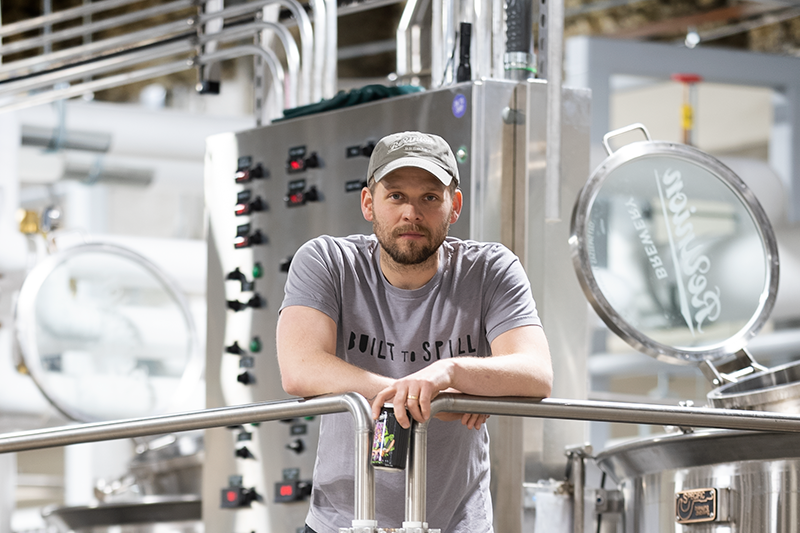
Picture a college student in a tiny Iowa City apartment, a five-gallon kettle bubbling on a stove that was never meant for the job. He isn’t plotting a career; he’s just making beer the way his dad taught him. More than a decade later, that student, Logan DePover, is one of the head brewers at Reunion Brewery, whose hazy IPAs, crisp Pilsner, and old-school West Coast IPA have become staples around the Iowa City area. In a conversation with Henry Nosek on the Midwest Microbrew podcast, DePover traced how a hobby became a livelihood and explained the one rule that shapes every beer Reunion makes.
The Past: How a Homebrewer Got Lucky
A Family Hobby on a Tiny Stove
DePover is local through and through. He grew up in the Quad Cities and moved to Iowa City for college, bringing along the homebrewing habit his father had introduced him to. “Kinda tiny apartment, five gallon brew kettle on my tiny little stove,” he says. “It’s kinda how I got into all this.” His dad still brews, and the two make beer together “every once in a while.”
His origin story, he says, is hardly unusual. “I’ve definitely met more brewers who got their start home brewing than going to school or, you know, technical classes or anything like that. The industry’s full of guys like me.” Henry agreed, noting that many brewers he has interviewed share the same arc, from Big Grove Brewery’s basement beginnings to the garage-brewing friends behind BIT Brewery.
Sneaking Onto the Packaging Line
The break came in 2013. A friend who had landed a job at Back Pocket Brewing was able to “kind of sneak me onto the packaging line,” DePover recalls, referring to the part of a brewery where finished beer is filled into cans and bottles. It was an entry-level spot, but it put him in the building at the right moment. “I got lucky,” he says. Within about six months, the brewery needed a shift brewer, and DePover found himself “learning on the job how to go from home brewing to professional brewing.”
That leap is bigger than it sounds: a commercial brewhouse means scaling recipes up and, more important, making the same beer the same way every time. DePover spent about two years absorbing those lessons at Back Pocket.
Building Reunion from the Ground Up
Then another opportunity arrived. DePover knew the people opening Reunion, and they asked whether he wanted to help start the place. He has been there since 2015. “It’s been crazy, it’s already been ten, eleven years,” he says. “Kinda wild.” What began as a single brewpub in Coralville, “the brewery that started it all,” has grown to include a larger production facility on the east side of town and a newer “mini brew pub” in downtown Iowa City.
The Present: Brewing What You’d Happily Drink
One Simple Rule
Ask DePover about Reunion’s brewing philosophy and the answer is refreshingly plain. “We brew what we like, and we just kinda tend to think that if we like it, other people are gonna enjoy it as well.” That means staying true to their own palates, skipping most of the big trends, and favoring classic styles and drinkable beers. Even the sours reflect it. “Sours can get crazy, crazy acidic,” he notes, but Reunion has always kept its versions “a little more balanced.”
The test for any new beer is blunt. “If we wouldn’t drink it ourselves, we don’t really plan on putting it in a tank and putting it on draft or in can or anything like that.” The goal is to “make beers where you want to drink more than one or two and you could sit with it all night.”
Trial and Error, and a Hazy Best Seller
Conveniently, Reunion’s tastes and its customers’ tastes have lined up. “Fortunately for us, our best sellers have been the ones that we’ve kind of drank a lot,” DePover says. The clearest example is the hazy IPA, a cloudy, unfiltered style known for soft bitterness and juicy hop aroma that took over craft beer in the mid-2010s. As DePover puts it, “hazy’s still king.”
Shortly after Reunion opened, around 2016, the brewery began making Tank Puncher and Juice Factory. The inspiration started at a bottle share, where DePover and some local friends got hold of cans from Trillium, the Massachusetts brewery known for its hazies, and he began researching the yeast behind them. The early versions weren’t quite what they are today, and he’s fine with that. Reunion is “consistent with our batches,” he explains, but “not afraid to let beers evolve a little bit, especially in the early stages.” It’s a lesson that reaches well beyond the brewhouse: “That’s how I’ve always learned kind of everything in my life. You gotta kind of mess up a couple of times to get it perfect.”
The Hazy Trio
Three of Reunion’s core beers are hazies, and each was designed to taste distinct. “Hazies can do the thing where they kind of blend together style-wise, and a lot of them can taste very similar,” DePover says. “We wanted to give kind of a bisect of what different hops can do.”
Tank Puncher, the best seller, is a 7 percent hazy IPA built on Mosaic and Ekuanot hops, leaning tropical with pineapple, guava, and mango. Juice Factory, a 6 percent hazy pale ale brewed with Citra, Amarillo, and Centennial, tilts toward citrus. Pounder, at 5 percent, uses only Centennial and began as a one-off in the taproom before earning a permanent spot. “Centennial by itself with our hazy yeast strain just kicks out this super bright lemon peel thing,” DePover says. Together the three make what he calls “a sliding scale,” from bright lemon to juicy orange to “really in your face tropical.”
A Pilsner, a West Coast Classic, and Seasonal Surprises
Reunion’s love of easy drinking shows in its Floral Pilsner, a take on a traditional German-style Pilsner. Rather than the usual German hops, the brewers picked Mount Hood, a Hallertau derivative grown in the Pacific Northwest that DePover calls a “cool kind of old school hop,” and paired it with Czech Saaz. Together they produce “that really fresh herbal floral thing” over a grain bill, or list of malts, that is 100 percent German Pilsner malt. “It’s really simple grain bill, but it tastes great.”
The other anchor is Reunion IPA, the first IPA the brewery ever made and a throwback to the West Coast style: “really dry, light, really classic,” the kind of beer you would have found in California or Oregon in the early 2000s. Brewed with only Columbus and Chinook hops, it delivers “this dank West Coast pine forest kind of experience.” With drinkers circling back to the style, DePover is glad the brewery was prepared. “We kinda had it ready and waiting. So that’s definitely a favorite.”
Around those cores, Reunion rotates in variety: a sour about every three months, the occasional bigger hazy IPA when the brewers want to try something fun, and stouts with playful ingredients, including an oatmeal cookie raisin stout and a peanut butter stout. At both taprooms, a creamy nitro Irish stout is a favorite.
The Wild Card: A Beer That Aged Itself
Asked for his most experimental beer, DePover points to a Brett IPA brewed a few years ago at the Coralville location. Brett, short for Brettanomyces, is a wild yeast prized for funky, fruity flavors and feared by many brewers because it can spread and spoil other beers. His team brewed the beer as if it were a hazy, fermented it with Brett C, and poured a liquid hop product over the top. The yeast delivered “the most like rotten warm pineapple tropical thing,” he says. “It was crazy.”
Once production moved to the larger facility, the Coralville brewery was under less pressure, so the team decided to “sacrifice this one tank” as a dedicated Brett tank and invited Wake Brewing of Rock Island to collaborate. “It was a little intimidating because we hadn’t messed around with Brett too much,” DePover admits, “but now that we’ve done that a couple of times, it’s not as big of a deal, I don’t think.”
The best chapter came by accident. A keg was stored away, forgotten, and rediscovered about two years later. Some of the dry-hop aroma had faded, but “the yeast just carried so much of this funky, really overripe fruit thing.” They tapped it to see how it tasted, and it was awesome. His advice to fellow brewers: “If you’re not afraid to get Brett in your brewery, give that a try, because it was a lot of fun.”
The Work Behind the Glass
The biggest misconception about brewing, DePover says, is that it’s all sitting around drinking and studying glasses. “It’s very dirty work. You get wet, you get blasted with stuff, kegs are very heavy.” It’s “very rewarding,” he adds, but “it’s definitely still a job.”
That work ethic anchors his advice to aspiring brewers. “If you’re really passionate about it, keep chasing it. You never know what can happen.” He never imagined he would brew for a living, he says; he simply kept talking to people about beer and kept practicing at home. When luck came, he was ready. “Once you get in a spot, just work your butt off and show that you’re somebody capable of doing it.” His bottom line: “Don’t give up if you’re trying to get into it. You can do it. Anybody can. I did.”
The Future: Festivals, Collabs, and Two Taprooms
Oktoberfest Season
Next on the calendar is the Northside Oktoberfest, set for Saturday, September 26, the festival’s 30th anniversary, and the start of what DePover calls “my favorite beer drinking time of the year.” Football is starting, Märzens and festbiers are everywhere, and the weather cooperates. “It’s nice to sit on a patio, the humidity’s gone, the beers are getting a little darker.”
A New-School West Coast IPA
The bigger news is a collaboration with Clock House Brewing in Cedar Rapids (see our Clock House listing), still in its early stages. The plan is a modern West Coast IPA using Superdelic, a new hop the brewery hasn’t used before, along with terpenes, the aromatic compounds that give hops their scent, and the same liquid hop product from the Brett IPA. The goal, DePover says, is “a kind of classic West Coast, but with more new school varieties and hop techniques,” something he has wanted to do for a long time. The two breweries have teamed up before, on a “really super overfruited, sour, crazy thing.” The hope is a late-fall release.
Where to Find Reunion
Staying current is easy. DePover recommends following Reunion Brewery on Instagram and checking the website. The beers are “pretty much everywhere locally,” so he suggests asking at your neighborhood Hy-Vee, John’s Grocery, or Bread Garden Market where the Reunion beer is.
Better still is a visit. The original Coralville brewpub has sixteen taps and a view of the brewery. The downtown Iowa City brewpub has a different menu, a great patio, and a fun spot to catch an Iowa game; hours and directions are in our Iowa City ReUnion listing. “Don’t sleep on either location,” DePover says.
From a five-gallon kettle to sixteen taps, the yardstick hasn’t changed: if it tastes good to the people making it, it’s ready to share.
Want more Iowa brewery stories? Browse Midwest Microbrew’s Iowa directory and brewmaster interviews.

