
How a hobby farm on the outskirts of Ames, Iowa became one of the region’s most beloved craft beer destinations — and why its best days may still be ahead.
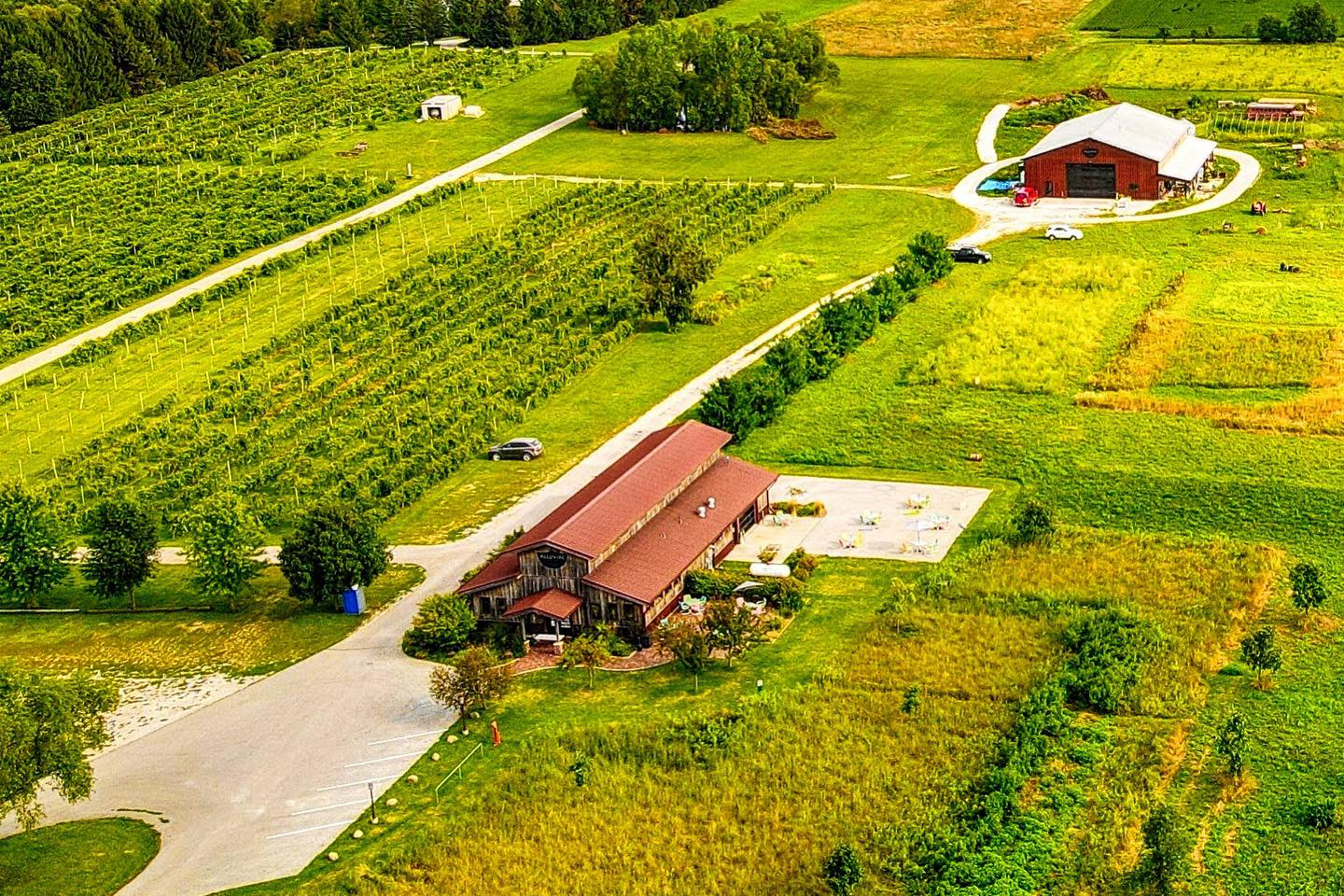
There is a particular kind of magic that happens when the right people, the right place, and the right moment all converge at once. For Alluvial Brewing Company, that moment arrived in 2015, on a sprawling sixty-acre property just north of Ames, Iowa, where a fruit and vegetable farmer named Elliot Thompson had been quietly tending the land next door to Prairie Moon Winery. What started as a question — how do we get more of the community out here to enjoy this beautiful space? — grew into something that eleven years later draws families, professors, bluegrass lovers, and serious craft beer enthusiasts from across the state.
Today, Alluvial is not just a brewery. It is an experience, a gathering place, and a reflection of the landscape that surrounds it. The taproom sits at the edge of a restored native prairie. Art covers the walls. A stage in the back hosts folk bands, jazz acts, and local favorites who have inspired at least one audience member to take up the banjo. And behind the bar, head brewer Neil Blair — four years into the job and more energized than ever — is quietly producing some of the most distinctive and thoughtfully crafted beer in central Iowa.
From Farmland to Taproom: The Origin Story
Elliot Thompson does not describe himself as someone who set out to open a brewery. He describes himself as someone who was farming. In the early 2010s, Thompson was running a fruit and vegetable operation on the property adjacent to Prairie Moon Winery, drawn in by the agricultural energy of the place and the natural beauty of the land. But as the years passed, he began to think bigger. “We were just kind of thinking of other ways to get more community members out there,” Thompson explained, “and just to enjoy the space and kind of share it all with everybody.”
The catalyst arrived in the form of two friends: Matt Nessen, who was working at Prairie Moon at the time, and Jason Peterson, who had just left his previous brewing job. The three of them began talking, and as Thompson puts it, it “just kind of spawned” into what Alluvial is today. The name itself is a nod to the land — alluvial refers to the sediment deposited by flowing water, a quiet geological tribute to the Iowa landscape that cradles the brewery.
When the doors first opened, the operation was decidedly modest. The brewing happened in the back of the taproom building, and the tasting room up front held just forty-eight seats. “You know, had no idea how it was going to go out in the country,” Thompson recalled. “The original tasting room was just in the front. It was just kind of a little like hobby farm next to the vineyard.” What nobody anticipated was how quickly the community would embrace it — or how deeply Alluvial would embed itself into the fabric of Ames.
A Taproom Like No Other: The Alluvial Experience
Scenic, Unplugged, and Community-Focused
Ask Thompson or Blair to describe Alluvial in one sentence, and they will likely arrive at the same phrase: “scenic, unplugged, and experience-focused.” It is a description that carries real weight. There are no televisions at Alluvial. Instead, the walls are hung with local artwork and populated with houseplants, creating an atmosphere that feels warm, lived-in, and deliberately human. The patio stretches out to meet a restored native prairie, and in the spring, summer, and fall, sitting outside means being poised right at the edge of a living landscape.
“We like to foster a good communal experience,” Blair explained, and the evidence of that philosophy is hard to miss. Visitors to Alluvial have noted that conversations spring up between tables spontaneously — strangers talking across the room as if they have always known each other. The absence of screens, combined with the presence of music, art, and great beer, creates the conditions for genuine human connection. It is the kind of place that is increasingly rare.
Live Music and the Soul of the Stage
Perhaps no single feature defines the Alluvial experience more than its live music program. The brewery has a stage in the back of the taproom, and it has become one of the premier venues in the Ames area for folk, bluegrass, jazz, rock, and jam bands. Local acts like the Iowa No Mountain Boys play regularly, drawing multigenerational crowds that spill across the taproom and out onto the patio. Thompson lights up when he describes these nights. “A lot of times when I see kids running around the back during shows and just families kind of coming and going like they own the place — those are some of my favorite memories.”
The Iowa No Mountain Boys are a particular point of pride. They play monthly residencies throughout the winter and have become something of a beloved institution at Alluvial. The band will headline the brewery’s eleven-year anniversary celebration, a milestone that Thompson describes with visible satisfaction. The music program extends well beyond any single act, however. Comedy nights, trivia evenings, Celtic bands, and seasonal celebrations fill the calendar throughout the year, and the nearby Iowa State University brings in faculty events, graduation parties, and club gatherings that ensure Alluvial touches nearly every corner of the Ames community.
Family, Dogs, and the Door Is Always Open
Alluvial is emphatically family-friendly, and not in a perfunctory, checked-box sort of way. The space genuinely welcomes all ages, and the culture of the taproom reflects that. “Bring the family, bring the dog,” Thompson offered simply when asked what first-time visitors should know. The large shared parking lot with Prairie Moon Winery means getting in and out is easy, and the brewery operates on an open, come-as-you-are basis — no table reservations, no formal menu beyond the popcorn that has been a staple for eleven straight years. Order at the bar, find a seat, and make yourself at home.
The Beer: Craft, Philosophy, and a Few Surprises
The Core Lineup and a Brewer’s Creed
Neil Blair arrived at Alluvial four years ago, bringing with him a career forged across several Iowa breweries and a philosophy he can articulate with refreshing candor: “If it’s worth doing, it’s worth doing right.” He does not rush his beers. He does not cut corners on ingredients. And he has been given something rare in the brewery world — genuine creative freedom. “Elliot’s pretty good about giving me free reign to the brew house,” Blair said, “so if there’s something weird I want to try, we just kind of do it.”
Alluvial’s two closest things to flagship beers are the Gilbert Gold, a pre-Prohibition style corn lager named after the small town just north of the brewery, and the Luchus, a Citra-hopped hazy pale ale. Both appear on tap nearly every day of the year. Around them, the rest of the lineup rotates through a thoughtfully curated diversity of styles — three or four IPAs or pales, something in the amber family, and whatever seasonal or experimental offering Blair has been working on. It is a tap list designed to introduce drinkers to the full range of what craft beer can be, not to overwhelm them with sameness.
Seasonal Stars and the Local Harvest
One of the most beloved seasonal releases at Alluvial is the O’Henry Batas, a sweet potato autumn ale that captures the brewery’s agricultural roots in liquid form. Blair sources the sweet potatoes from the organic vegetable farm located a short distance from the brew house, cleans and peels them by hand, steams them on site, and incorporates them directly into the mash. The result is an ale with maple and vanilla notes that keep company with the unmistakable earthiness of locally grown sweet potatoes — grown, as Blair pointed out, “literally 150 yards from the brew house.”
This winter, however, a different beer has stolen the spotlight. The Morinon, Alluvial’s Schwarzbier, has surpassed even the Gilbert Gold as the week’s top seller — a development that surprised even the man who brewed it. “I brew it because I love Schwarzbier,” Blair admitted with a laugh. He recommends it as the ideal entry point for craft beer newcomers: dark enough to intrigue, approachable enough to welcome, and what he calls “beer-flavored beer.” For the more adventurous, the Last Spell — a quad-vanilla imperial stout aged more than two years in barrels, crafted with vanilla beans from Madagascar, Uganda, Tahiti, and Tanzania — offers a very different kind of revelation, one that demonstrates, as Blair put it, “that craft beer isn’t just all bitter” and that the category is “one of the most, if not the most, diverse types of beverage in the world.”
Wild Fermentation and the Art of Letting Go
For the most dedicated craft beer enthusiasts, Alluvial’s most fascinating work is taking place quietly in barrels. Blair has been producing a series of spontaneous sour ales under the Archa label, using a makeshift coolship that he sets outside in the late winter or early spring to capture wild microbes from the surrounding environment. Given that the brewery sits next to a winery and an organic farm — both rich in beneficial yeast and bacteria — the results have been, in Blair’s word, surprisingly good. The beer is left to ferment for roughly a year, and some batches are then refermented on red raspberries or Marechal Foch grapes from Prairie Moon Winery. “Basically nobody in Iowa is really doing it,” Blair explained, “so I figured I could do it myself.”
The current Archa is available in bottles at the taproom — not sour enough to intimidate, and surprisingly floral, with a complexity that rewards patience. Batch three is already on its way. For those who want something even more boundary-pushing, there is the Riperia, a hazy IPA brewed in collaboration with Pulpit Rock Brewing in which roughly twenty percent of the volume is replaced with fresh-pressed white grape juice from the winery next door. The grape variety changes with each batch, altering the hop profile to match — the most recent version used Briana grapes with their pineapple and bubble-gum character, complemented by Nelson, Eldorado, and Idaho 7 hops. The acid from the grape juice pushes the final product into sour ale territory, creating something genuinely difficult to categorize and deeply satisfying to drink.
The Craft Beer Landscape — and Where Alluvial Fits
Ames is not a sprawling craft beer city. Beyond Alluvial, the primary local counterpart is Torrent Brewing closer to downtown, with Fence Line Brewing in nearby Huxley rounding out the closest options. The proximity to Iowa State University brings a steady stream of faculty, graduate students, and the occasional undergraduate, though Blair notes with gentle amusement that roughly half the campus is under the legal drinking age. The market is focused, loyal, and genuinely curious about quality.
What Blair sees in the broader trends offers an interesting window into where the industry is heading. Lager styles are surging. ABV is trending downward. Hazy IPAs remain strong. And Iowa, by Blair’s estimation, tends to follow coastal trends by about two to three years — meaning the Alluvial team can look at what is happening in California or New Jersey right now and make educated bets about what Iowa drinkers will want soon. The lower-ABV movement has already had a measurable effect: more items sold per ticket, longer stays, happier guests. “It’s a lot easier to drink two beers when it’s 4.5% rather than 7%,” Blair observed.
What’s Next: Distribution, Growth, and the Next Chapter
For eleven years, Alluvial handled its own distribution, hauling kegs in a U-Haul to Ames, Ankeny, Des Moines, and a handful of other central Iowa locations. That chapter has now come to a close. Just before this interview, Alluvial signed on with Confluence, a distributor that will carry its beer across the entire state of Iowa. The scale of the change hit Thompson with satisfying immediacy: “We just ran into a U-Haul the other day and took down four pallets of beer, which we’ve never done before.”
The partnership with Confluence means that Alluvial’s beers — the Gilbert Gold, the Morinon, the Luchus, and whatever seasonal or experimental creation Blair has been perfecting — will soon be findable in places where the brewery has never had a presence. For anyone who has been meaning to make the drive north of Ames and simply hasn’t gotten around to it, this is the year distribution catches up to them. And for anyone ready to make the trip in person, Alluvial will also be pouring at the Iowa Craft Brewfest in Des Moines on June 6th.
But the heart of Alluvial has always been the taproom — the sixty acres of vineyard and prairie and farmland, the art-covered walls, the stage, the families and dogs and professors and curious newcomers discovering that craft beer can be a carrot cake sour or a wild-fermented lambic or a silky Schwarzbier that nobody expected to become the bestseller of the winter. After eleven years, Thompson and Blair have built something that feels both deeply rooted in its place and genuinely open to wherever the next idea leads. That combination of rootedness and restlessness is, in the end, what makes a great brewery.
Visit Alluvial Brewing at alluvialbrewing.com for current tap listings, upcoming concerts, and events.

