Every craft brewery has an origin story, but few start with a decades-old grudge against a piece of missing equipment. For Reunion Brewery, the Iowa City-area beer institution now approaching its tenth anniversary, that grudge belonged to co-founder Jim Mondanaro — and it took him nearly 35 years to settle the score.
Kris Mondanaro, Jim’s wife and the company’s COO, has been there for most of that journey. In a wide-ranging conversation, she walked through how a family pizzeria quietly grew a brewery inside itself, how a can of beer became the company’s real identity, and how two very different buildings — one in Coralville, one in downtown Iowa City — now tell two chapters of the same story.
An Awkward First Year
Reunion Brewery didn’t begin as a brewery at all. It began as an idea bolted onto an existing restaurant, and for a while, nobody was quite sure what to call it. “My husband started Reunion Brewery back in 2016. I think first it was the Draft House,” Kris explained. “We went through kind of an awkward stage where we weren’t real sure what we were doing.”
The roots go back further, to Mondo’s Tomato Pie in Coralville, open since 1994. Around 2015, Jim decided it was time to revisit an ambition he’d tried and failed at decades earlier. “He had initially tried to do a brewery in the ’80s and his equipment never showed up,” Kris said. “So he waited another 35 years to get back in the business.”
To actually make beer, the Mondanaros brought in an outside consultant with deep industry roots to help develop early recipes and teach the team different brewing styles. But the person who became the face of the beer was hiding in plain sight: Logan De Pover, still Reunion’s brewmaster today, was working in the cheese department at Bread Garden Market. “What do you know — Logan all of a sudden was our brewer,” Kris said. De Pover had been homebrewing for years in Iowa City’s club circles, and was more than ready when the opportunity appeared.
There’s a small irony baked into those early days. Jim, the man who bet his business on beer, initially wanted nothing to do with anything but a lager. “The irony in that is now IPAs are his preferred beverage,” Kris said, laughing — a shift she compares to acquiring a taste for a more sophisticated wine.
Turning a Side Project Into a Brand
The turning point for Reunion wasn’t a boardroom decision — it was an identity crisis resolved by the brewing team itself. About a year in, Logan and his crew pushed back on the fuzzy branding that still had the operation tangled up in the “Mondo’s” name. Their argument was simple: if the business was going to be a brewery, it needed to commit fully.
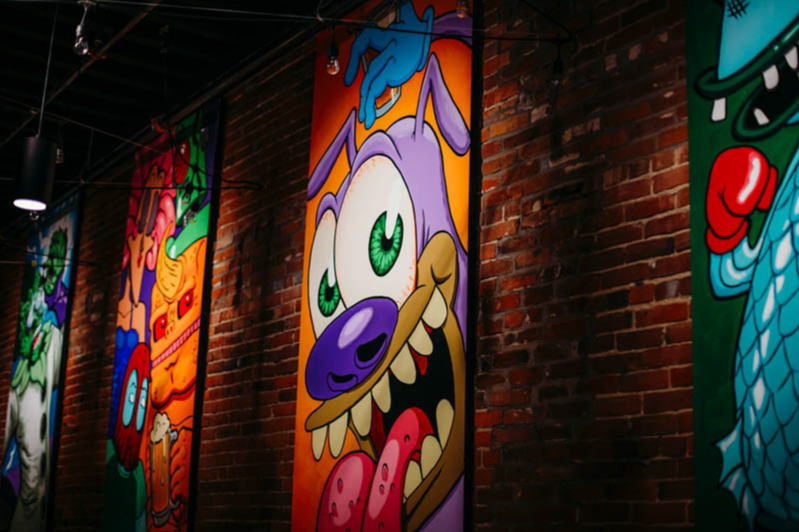
That commitment showed up almost overnight in the form of loud, unconventional can art — and then, in a story that’s become local folklore, actual graffiti on the outside of the building. “We went all into the wacky art that is our cans, and someone graffitied the outside of our business to match kind of those aesthetics,” Kris said. The rebrand was convincing enough that longtime customers assumed the building had genuinely been vandalized. “People were calling for weeks afterwards trying to ask Jim if he knew that our building had been vandalized,” she recalled. “We’re like, yeah, that was intentional.”
Out of that shift came the beers that would define Reunion’s reputation: Dr. Dank as an early specialty release, followed by fan favorites Juice Factory and Tank Puncher, alongside a rotating lineup of lagers. A decade later, those names remain shorthand among regulars for what Reunion is about — bold, brightly labeled beer brewed by a team that genuinely loves the craft.
Riding Out an Industry in Flux
Ask Kris what the last ten years have actually been like, and the answer isn’t nostalgic — it’s practical, even a little weary. “Right now nationally, beer consumption is down. All the COGS are up — CO2, rent, grain — and then you have the craziness going on with tariffs and whatnot,” she said. Aluminum, she noted, has become its own quiet crisis for anyone canning beer. Reunion also survived COVID, an experience Kris describes as an industry-wide crash course in adaptability.
One of the more unexpected recent chapters involves a business Reunion almost entered: THC beverages. As competitors like Big Grove and Field Day pushed into the infused-drink space, Reunion explored the same path, partnering with a Minnesota company and preparing to order a full pallet of its own branded THC products. Then the insurance call came. “They’re like, ‘Hey, we heard that you’re doing this, and P.S., it’s not covered under your dram shop insurance. So it’s gonna be $8,500 for each of your businesses to do it,'” Kris said. “We were like, wow, that’s pretty much the profit. So what are we doing?” Reunion backed off.
She suspects an upcoming regulatory shift, expected this November, has less to do with public safety than lobbying from national distributors worried about young adults favoring THC drinks over beer. Whether the change takes effect remains to be seen — but the money at stake is enormous.
Two Buildings, Two Very Different Businesses
If the first decade of Reunion was about figuring out what kind of brewery it wanted to be, the last four years have been about running two very different businesses at once. The original Coralville location and the newer Iowa City spot, which opened four years ago inside the downtown market, share a name and a beer list but little else.
Coralville houses the larger brewing system — seven barrels versus downtown’s five — inside roughly 15,000 square feet. Iowa City occupies a smaller footprint, 5,000 to 7,000 square feet, but makes up for it with 650 seats across a main floor, a basement, and a second-floor dance space open until 2 a.m. on weekends. “This is like doesn’t really sleep over here,” Kris said, describing a cleaning crew arriving around five or six in the morning just as the night’s bartenders finally clock out.
The decision to open downtown was strategic more than aspirational. Kris admits she wasn’t thrilled at the prospect of a fifth business, but the calculation was simple: get Reunion’s beer in front of the crowds already flooding downtown for football and basketball games, and introduce the brand to people who might never have found it otherwise. “If we can get our beer downtown in more people’s hands… that was kind of our thought,” she said.
Running a multi-floor, late-night venue also came with hidden costs that don’t show up until the first invoice arrives. “Your POS, or your software, is higher because you have to have terminals on every floor,” Kris explained. Staffing follows the same logic — every floor needs people on it, or the business is effectively paying taxes on space that isn’t generating revenue. Despite the overhead, the space has become a hub during marquee sports moments, like Iowa women’s basketball games during the Caitlin Clark era, and doubles during the week as a private event venue for rehearsal dinners and university functions before 9 p.m. — “a nice way to make extra money,” Kris said, that helps offset the late-night grind.
The downtown market also nudged Reunion’s beer lineup in a new direction. The company developed OG Gold and OG Light, lighter, more approachable beers positioned as answers to Bud Light and Budweiser, recognizing that not every visitor wants an 8% IPA in a 16-ounce can. “I think some people don’t recognize that’s like drinking two glasses of wine,” Kris said, describing the lighter options as a way to help customers pace themselves while still having a good time.
Regulars, Recipes, and Building a Taste for Craft Beer
Ask Kris what keeps her in the business after a decade, and the answer has less to do with beer than with people. “We like beer, but if we didn’t like people, you couldn’t stay in this industry — there’s just no way you could do it,” she said. “You get to see the best of humanity.”
Nowhere is that clearer than in Coralville, where Reunion has built a loyal base of regulars who treat their orders like a signature. Kris tells the story of three longtime customers, coincidentally all named Scott, who drink the same East Coast IPA every visit without fail — so precisely that they once caught a batch brewed with the wrong bag of grain. “This doesn’t taste right,” they told staff, insisting the beer had just been brewed and couldn’t be stale. Reunion investigated and confirmed the batch was, in fact, off. “We have to rebrew that, but here’s some cans to get you by, because that’s what they want to drink,” Kris said.
That kind of loyalty doesn’t happen by accident. Kris sees parallels between craft beer and other acquired tastes, coffee among them: “You look at Starbucks — people acquire a taste. You’ve gotta get people to get a taste for your beverages.” Not every customer wants to be converted, and she respects that. But she delights in the success stories, like the longtime Miller Lite drinker Reunion converted to Juice Factory, one of its boldest beers — “a really big stretch,” she said.
Looking ahead, Kris admits there’s untapped potential in areas like beer dinners, a format she admires when other Iowa City breweries pull it off well. Between running four hospitality businesses, the bandwidth hasn’t always been there, but it’s clearly on her radar. “I think that’s the neat thing about Iowa City — we have such an amazing food scene,” she said.
A Brewery Rooted in Its Community
Beyond the beer, Reunion has quietly become a connective thread in Iowa City’s civic life. The brewery participates every year in Taste of Iowa City and the downtown Block Party, two events that draw thousands of people. It also partners with Little Village on the Roast of Iowa City and regularly opens its doors, free of charge, to local nonprofits like Houses Into Homes — a gesture Kris frames as especially important given recent federal funding cuts to community organizations.
That openness has occasionally created friction, and Reunion has learned hard lessons about vetting the groups it hosts. Kris described one incident in which a group booked a private event without disclosing its political affiliation, only to reveal, hours before the event, that it was tied to a candidate whose messaging didn’t reflect the company’s values — and was disrespectful to staff. The fallout prompted Reunion to add explicit language to its event contracts: any hate speech at a booked event results in immediate cancellation, with no refund — a policy born directly out of protecting the staff who make the venue run.
Supporting the Neighborhood Brewery
As the conversation wound down, Kris’s message to prospective visitors was less a sales pitch than a plea on behalf of an entire industry under pressure. With costs for cans, CO2, and labor all climbing, she believes independent breweries need every bit of community support they can get. “Everybody’s going through a really hard time right now,” she said. “Most of us love — we wouldn’t be here if we didn’t love you coming in our doors. So go in and support your local brewery.”
Nearly a decade after a graffiti prank turned a struggling side project into a real brand, Reunion Brewery’s story is still being written across two buildings, two brewing systems, and a community that has, in Kris’s telling, quite literally acquired the taste. Whether it’s three regulars named Scott defending their IPA, a first-time visitor discovering OG Gold on a football Saturday, or a nonprofit hosting a fundraiser in a room Reunion gave away for free, the throughline is the one Kris keeps coming back to: a business built on the people who keep showing up.
For more founder stories like this one, explore our full library of Brewmaster Interviews or browse the rest of our Iowa brewery directory.