Every May, something shifts in the Midwest. The patios fill up, the grill smoke rolls in, and a heavy IPA suddenly feels like work. That’s wheat beer season. Bell’s Oberon hits Michigan shelves like a holiday. Boulevard Zon comes out of cold storage in Kansas City. New Glarus Dancing Man shows up in Wisconsin again.
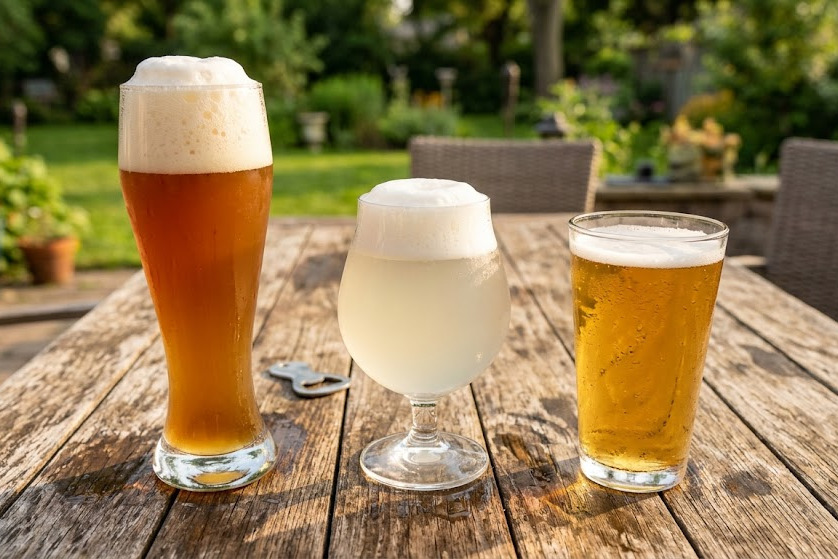
If you’ve ever been told to “start with a wheat,” this wheat beer guide for new craft drinkers explains what that means. Three different beer styles share the wheat beer name, and the best summer craft beers for beginners are spread across all three. The quickest way to keep them straight: hefeweizen flavor comes from the yeast, witbier flavor comes from the spice rack, American wheat beer flavor comes from the malt and hops. These light refreshing beers for summer 2026 each solve summer in a different way.
- Hefeweizen Flavor Profile Explained: Banana, Clove & Bavarian Tradition
- Witbier Flavor Profile: Citrus, Spice & Belgian Roots
- American Wheat Beer vs Hefeweizen: The Best Craft Beer Style for Beginners
- Best Seasonal Wheat Beers from Midwest Craft Breweries
- Hefeweizen vs Witbier Taste Comparison: How to Choose a Wheat Beer Style
- How to Serve Hefeweizen at Home (and All Three Styles)
- Wheat Beer FAQ: Your Questions Answered
- Wheat beer FAQ — five questions answered about hefeweizen, witbier, and American wheat beer styles
- Best Wheat Beers for Beginners: Where to Start This Summer
Hefeweizen Flavor Profile Explained: Banana, Clove & Bavarian Tradition

The first thing you notice in the glass is the color — deep gold, hazy, topped by a white foam head that won’t quit. Then the aroma hits: banana, fresh bread, a sharp edge of clove. That’s a hefeweizen, and all of it comes from the yeast. Nothing is added to the kettle to make it taste that way.
The 2021 BJCP Style Guidelines (10A) set the range at 4.3–5.6% ABV and 8–15 IBU, with at least 50% malted wheat in the grain bill. The banana note comes from a compound called isoamyl acetate. The clove note comes from 4-vinyl guaiacol. Bavarian Weizen yeast strains make both naturally — no fruit or spice needed. Cooler fermentation pulls toward clove; warmer fermentation pushes toward banana. The style traces to a Bavarian royal brewing monopoly that Georg Schneider bought in 1872, and the modern weissbier flows directly from there.
Witbier Flavor Profile: Citrus, Spice & Belgian Roots
A witbier is built on a different idea. All of a hefeweizen’s flavor comes from the yeast. A witbier’s character comes from what the brewer adds to the kettle — freshly ground coriander and dried Curaçao orange peel. Real spice, real citrus.
The BJCP 24A guidelines classify it as a Belgian ale with around 50% unmalted wheat and barley malt, running 4.5–5.5% ABV and 8–20 IBU. The style nearly died out in the 1950s before a Belgian milkman named Pierre Celis brewed it back to life in Hoegaarden in 1965. Pour one and it looks almost white — “wit” is Flemish for “white” — with coriander and sweet orange peel on the nose, soft spice through the middle, and a tart-dry finish.
American Wheat Beer vs Hefeweizen: The Best Craft Beer Style for Beginners
If you’re coming from light lager, the American wheat beer is your on-ramp. Among craft beer styles for beginners, it’s the easiest start — clean, a little citrusy, nothing aggressive.
The BJCP 1D guidelines put it at 4.0–5.5% ABV and 15–30 IBU with 30–50% wheat in the grain bill. The yeast is the whole story in the american wheat beer vs hefeweizen comparison: American wheats use a POF-negative strain that shuts down banana-and-clove production entirely — the BJCP flags those flavors as inappropriate for style 1D. What you get instead is bready malt working with modern hops, which gives you lemon, citrus, and a little floral lift. Unfiltered wheat beer flavor and aroma leans toward lemon zest and fresh grain. The style started with Anchor’s 1984 Summer Wheat and went mainstream when Widmer Brothers sent an unfiltered wheat to Portland’s Dublin Pub in 1986, creating the American hefeweizen tradition largely by accident.
Best Seasonal Wheat Beers from Midwest Craft Breweries
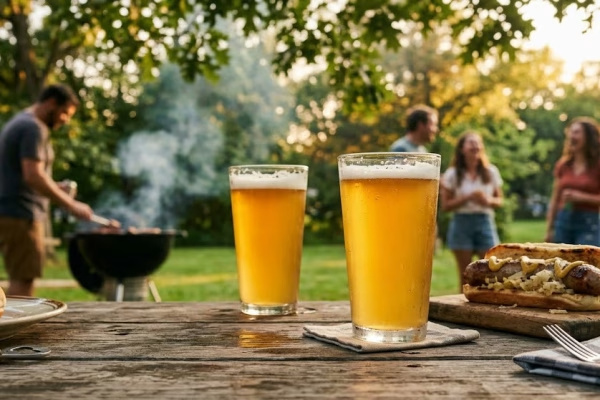
All eight beers below are in production as of Spring/Summer 2026, covering the best hefeweizen beers in the midwest, the top witbier beers to try this summer, and the standout American wheat picks across five states.
Bell’s Oberon Ale — Comstock, MI (American Wheat) | Seasonal: March–September Michigan runs on this beer from March to September. Bell’s Brewery has made it since 1985 with four ingredients only — water, barley malt, wheat, and Saaz hops. No citrus added; that bright lemon-orange character is all yeast and hops. 5.8% ABV / ~25 IBU. Pairs with grilled fish, brats, summer salads.
Goose Island 312 Urban Wheat — Chicago, IL (American Wheat) | Year-round One of the best craft wheat beers in Illinois, brewed unfiltered at this Chicago craft brewery since 2004 and named for the city’s original area code. Gold Medal, 2010 Great American Beer Festival. Bright lemon on the nose, creamy wheat body. 4.2% ABV / 18 IBU. Pairs with hot dogs and grilled tacos.
Boulevard Unfiltered Wheat — Kansas City, MO (American Wheat) | Year-round This midwest craft brewery’s best-selling beer in the region. Bottle-conditioned, naturally hazy, built for a porch. Lemon on the nose, light tartness, dry finish. Boulevard recommends a lemon wedge, not orange — and they’re right. 4.4% ABV / 14 IBU. Pairs with shrimp and goat cheese.
Three Floyds Gumballhead — Munster, IN (American Wheat Pale Ale) | Year-round The hop-forward outlier and a top fruity and spicy wheat beer recommendation for anyone who wants more bite. Dry-hopped with Amarillo; scored 95/100 by Craft Beer & Brewing in 2017. Grapefruit and peach on the nose, real bitterness underneath. 5.6% ABV / 35–38 IBU. Pairs with Thai food.
Boulevard Zon Witbier — Kansas City, MO (Witbier) | Seasonal: Spring Adventure Pack Boulevard’s most-decorated beer — six GABF medals. Fermented with Affligem Belgian yeast, spiced with coriander and dried orange peel. Coriander and sweet orange on the nose, soft spice in the middle, dry crisp finish. 4.4% ABV / 15 IBU. Pairs with mussels, white pizza, citrus salads.
New Glarus Dancing Man Wheat — New Glarus, WI (Hefeweizen) | Wisconsin only The Midwest’s benchmark hefeweizen, brewed since 1995 with 100% Wisconsin-grown wheat. BeerAdvocate rates it 94 (“Outstanding”). Banana, clove, cinnamon, and warm bread — full-bodied and aromatic. At 7.2% ABV / 12 IBU it edges above the BJCP 10A range into Weizenbock territory. Wisconsin-only distribution.
Dovetail Hefeweizen — Chicago, IL (Hefeweizen) | Year-round The most technically serious hefeweizen in Illinois — double-decoction mash, open fermentation, 95/100 from craft beer reviewers. Clove and banana on the nose, creamy entry, mandarin-orange mid-palate, dry peppery finish. 4.8% ABV / 16 IBU. Best Illinois craft brewery pick for a true Bavarian experience.
Utepils Ewald the Golden — Minneapolis, MN (Hefeweizen) | Year-round Best of Show at the MN Craft Brewers Guild Brewers Cup in 2019 and 2026. Brewed to Munich standards in Hennepin County. Ripe banana, sweet clove, pillowy mouthfeel, clean dry finish. 5.2% ABV / 14 IBU. The easy first midwest beer pick for Minneapolis drinkers.
Hefeweizen vs Witbier Taste Comparison: How to Choose a Wheat Beer Style
| Hefeweizen (BJCP 10A) | Witbier (BJCP 24A) | American wheat beer (BJCP 1D) | |
|---|---|---|---|
| Flavor driver | Yeast (banana, clove) | Spices (coriander, orange peel) | Malt + hops (bready, citrus) |
| IBU range | 8–15 | 8–20 | 15–30 |
| ABV range | 4.3–5.6% | 4.5–5.5% | 4.0–5.5% |
| Midwest pick | New Glarus Dancing Man | Boulevard Zon | Bell’s Oberon |
| Best glass | Weizen vase | Tulip / witbier tumbler | Pint or tulip |
How to Serve Hefeweizen at Home (and All Three Styles)
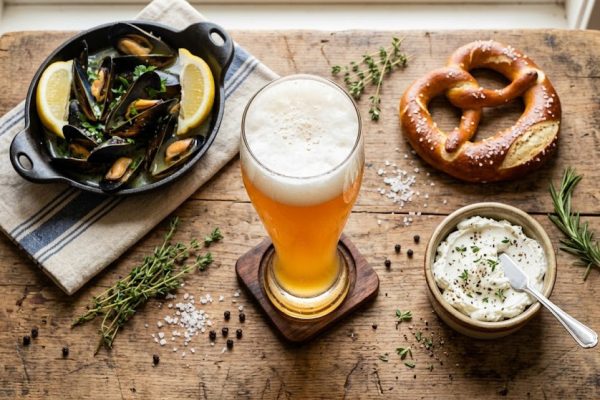
Temperature matters more than most people think. Witbier and American wheats want 38–42°F. Hefeweizens need a little more warmth — 42–48°F — so the banana and clove esters can open up. Below 38°F, all three go flat and tasteless.
For glassware, a weizen vase is purpose-built for hefeweizens — tall, hourglass-shaped, designed to hold the foam head and funnel the aroma toward your nose. A tulip works for all three styles. A pint is fine for American wheats.
The American Homebrewers Association calls the “pour-and-rouse” standard practice for hefeweizens. Rinse the glass with cold water, pour two-thirds of the bottle down the tilted side, then swirl the last inch to lift the yeast sediment and pour it down the center. The result is a hazy, full-flavored pour with a proper head.
Skip the lemon with a Bavarian hefeweizen — citric acid kills the foam and covers the clove. Lemon works with American wheats; orange is the right call for witbier. Per BJCP, hefeweizens and witbiers are fragile beers — drink them within 90 days of packaging.
Wheat Beer FAQ: Your Questions Answered
Wheat beer FAQ — five questions answered about hefeweizen, witbier, and American wheat beer styles
Best Wheat Beers for Beginners: Where to Start This Summer
Wheat beer season is short and these beers taste best fresh. Start with Bell’s Oberon or Goose Island 312 for the American wheat beer baseline, move to Boulevard Zon for the witbier experience, and track down a New Glarus Dancing Man in Wisconsin when you’re ready. Get the right glass, rouse the yeast, skip the lemon on the hefe.
Cheers to summer.